

| What Do We Value? Children’s Literature, Sustainability, and the Living World
Introduced by Alyssa Lowery |
Download PDF |
The word ‘sustainability’ circulates abundantly in our public life and institutions, often in connection to questions of ecology and our changing climate. In preparing to write this editorial, I began to consider what it means for something to be sustain-able. What does it actually mean to sustain something, and how do we decide what is worth sustaining? Questions of sustainability, I think, are closely connected to questions of value: what do we consider worth preserving, whose knowledges inform that judgment, and who has the authority to act upon it? Such questions extend beyond the protection of natural resources and threatened species to the preservation of languages, cultural traditions, and relationships among people and places. They are also deeply concerned with power, particularly as decisions about what ought to be protected are frequently made by those whose interests and experiences differ from those most directly affected.
In The Green Dialogues: Ecocritical Pathways to Children’s Literature in Education (2026), Campagnaro et al. approach ecocritical literacy through attention to relationships among human and non-human life, emphasizing the role of literature in fostering understanding of the complex environments we inhabit. Their approach offers a useful perspective on the broader questions of sustainability taken up in this issue of Recommended Reads, where four books explore the ecological, linguistic, cultural, and social relationships through which lives and communities are sustained.
Sunny Man Chu Lau recommends Melanie Florence and Gabrielle Grimard’s Stolen Words (2017), a picturebook exploring the consequences of colonial language suppression and the role of intergenerational relationships in restoring linguistic and cultural continuity. Megan R. Brown introduces Lynn Brunelle and Jason Chin’s Life After Whale (2024), an informational picturebook that traces the extraordinary ecological relationships sustained by the decomposition of a whale on the ocean floor. Nora Dåsnes’s Save Our Forest! (2024), a graphic novel suggested by Nina Goga, details the efforts of children who challenge adult authority in their efforts to protect a threatened local forest. Finally, I present Kate Samworth’s Aviary Wonders Inc.: Spring Catalog and Instruction Manual (2014), which satirically employs the conventions of a commercial catalogue to expose the troubling assumptions underlying the commodification of living creatures.
The texts recommended in this issue differ markedly in genre, format, and intended readership, but each raises questions about the relationships through which life, knowledge, and communities are sustained. They also offer distinct possibilities for English language education, from interpreting visual metaphors and informational illustrations to examining persuasive language, negotiating perspectives, and engaging in critical discussion. Through these activities, learners can consider the ways in which language and representation influence what we recognize as valuable and whose interests we understand as worthy of protection. Such engagement offers an opportunity to approach sustainability beyond ecological concerns and to consider the ways that power, knowledge, and responsibility underpin the central question of what we value.
References
Campagnaro, M., Ferrari, L., Goga, N., Graell, M., Pujol-Valls, M., Stengrundet, E. & Ulland, G. (2026). The green dialogues: Ecocritical pathways to children’s literature in education. Springer. https://doi.org/10.1007/978-3-032-10418-2. (2026). The green dialogues: Ecocritical pathways to children’s literature in education. Springer. https://doi.org/10.1007/978-3-032-10418-2
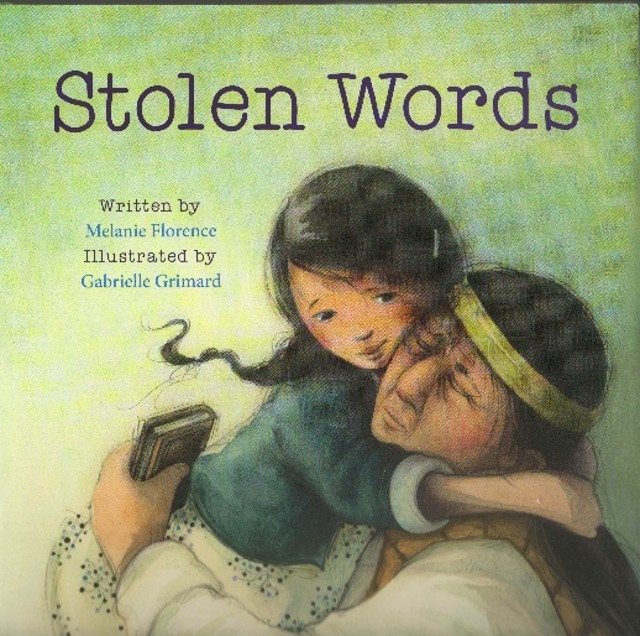
Florence, Melanie and Grimard, Gabrielle (illus.) (2017)
Stolen Words
Second Story Press
Recommended by Sunny Man Chu Lau
Engaging learners in Indigenous children’s literature provides a meaningful entry point to understanding Indigenous languages, cultures, and worldviews while fostering awareness about the historical and continuing impacts of colonialism and the ongoing need for reconciliation. Stolen Words (2017) provides an ideal resource for the aforementioned educational purposes. The book is written by Melanie Florence, Canadian award-winning writer of Cree/Scottish heritage, and illustrated by Gabrielle Grimard, a Quebec artist. The story starts with a little girl asking her grandfather to teach her some Cree words. However, the grandfather is unable to do so and begins to share how his words were stolen from him as a small boy in a residential school (see Fraser, 2020 to learn more about Canadian residential school system). The grandfather recounts how he and other children were stripped of their individuality through enforced clothing, uniform hairstyles, and most importantly, the suppression of their Cree language.
The illustrations are particularly compelling, generating rich metaphorical associations and emotional resonances that enhance the book’s thematic depth. For example, one particularly striking spread depicts rows of Indigenous children with identical haircuts and wisps of black smoke rising from their mouths and merging into the shape of a raven, which appears poised to be trapped in a birdcage held by an elderly White priest. For some Indigenous peoples, ravens symbolize guardian spirits (see Gadacz, 2015 for Raven Symbolism), and in the context of this story, the raven may suggest the intertwined connections between language, identity and spirituality, illustrating how language is deeply embedded in one’s sense of belonging, community, and spiritual heritage. To lose one’s language is to lose connections to identity, community and the knowledge forged through generations of living, learning and relating with one another and the land.
Upon hearing her grandfather’s story, the young girl borrows a Cree dictionary from school and sets out to help him recover his language. While the story poignantly depicts the intergenerational trauma and loss resulting from colonial language policies, it also offers a message of hope by highlighting the possibilities of collective efforts toward Indigenous language revitalization. Beyond raising awareness of Indigenous experiences, the book provides a valuable entry point for discussions about other minoritized language communities and invites students to reflect on their shared responsibility to support linguistic and cultural diversity in an increasingly interconnected world.
The Truth and Reconciliation Commission of Canada Calls to Action (2015) (National Centre for Truth and Reconciliation, n.d.) aims to address the enduring harm brought about by the residential school systems. Increasing attention is given to supporting teachers in developing Indigenized curricula and incorporating Indigenous ways of knowing into teaching and research, recognizing that responding to the Calls for Action is a shared responsibility of all educators and researchers, not just Indigenous communities alone (McIvor & Anisman, 2018). Indigenous communities tend to adopt a more holistic, relational, and land- (and water) based perspective toward language (Simpson, 2014). kakiyosēw Belinda Daniels, from Sturgeon Lake First Nation, Saskatchewan and Professor at University of Victoria, Canada (Daniels et al., 2025) argues with her co-authors that language is not merely a code that can simply be transmitted. Rather, it is rooted in place, through long-term relationships among people, environment, and more-than-human elements including other living and non-living things and spiritual forces that share the land. Languages are therefore deeply rooted in place, arising from people’s shared lives and experiences within the environment and carrying meaning that has been learned, lived, and passed down from generation to generation. They are, hence, relational, collective and embodied, shaped through relationships with community and the wider world (Simpson, 2014). Stolen Words provides a rich context for students to discuss the diverse ways language itself is conceptualized, lived, and experienced across different cultures and worldviews.
Bibliography
Florence, M. (2017). Stolen Words. Second Story Press.
References
Daniels, B., Sterzuk, A., Morin, R., Cook William, R., Thunder, D., & Turner, P. (2025). ‘ē-nitomikoyahkik kakīwēyahk [They’re Calling Us Home]’: Kinship, Land, and Wellness in Indigenous Language Revitalization. The Canadian Modern Language Review, 81(3), 214-235. https://doi.org/10.3138/cmlr-2024-0074
Fraser, C. G. (2020, May 6). Resistance and residential schools. In The Canadian Encyclopedia. https://thecanadianencyclopedia.ca/en/article/resistance-and-residential-schools
Gadacz, R. R. (2015, March 4). Raven symbolism. In The Canadian Encyclopedia. https://thecanadianencyclopedia.ca/en/article/raven-symbolism
McIvor, O., & Anisman, A. (2018). Keeping our languages alive: Strategies for Indigenous language revitalization and maintenance. In Y. Watanabe (Ed.), Handbook of cultural security (pp. 90–109). Edward Elgar. https://doi.org/10.4337/9781786437747.00011
National Centre for Truth and Reconciliation. (n.d.). Truth and Reconciliation Commission of Canada: Calls to action. https://nctr.ca/about/truth-and-reconciliation-commission-of-canada-calls-to-action/
Simpson, L. B. (2014). Land as pedagogy: Nishnaabeg intelligence and rebellious transformation. Decolonization: Indigeneity, Education & Society, 3(3), 1–25.
|
Sunny Lau, Full Professor at Bishop’s University in Quebec, is Canada Research Chair (Tier 2) in Integrated Plurilingual Teaching and Learning. She specializes in critical literacies, TESL, literature and language teaching, trans/plurilingual pedagogies, and participatory research methodologies. She co-edited Plurilingual pedagogies: Critical and Creative Endeavors for Equitable Language in Education (with Van Viegen, 2020) and Translanguaging in Action in English-Medium Classrooms (with Tian, 2026), both of which critically explore plurilingualism and translanguaging across educational settings. She has recently joined the editorial board of Children’s Literature in English Language Education. |
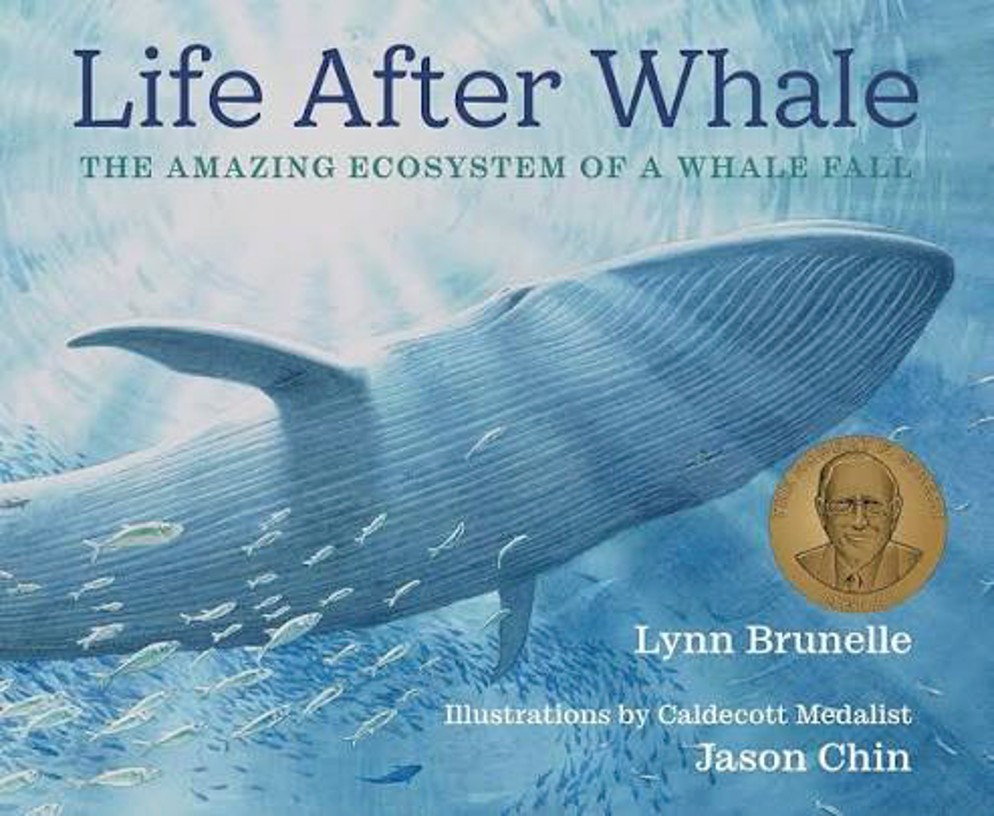
Brunelle, Lynn (2024)
Life After Whale: The Amazing Ecosystem of a Whale Fall
Neal Porter Books
Recommended by Megan R. Brown
Reading informational texts can lead to monotonous repetition of facts separated from emotional complexity. Although they play an important role in content-area reading, they can feel too much like textbook reading, particularly for older pupils. However, quality informational picturebook texts can avoid this challenge by connecting with the reader’s emotions and inviting them to consider the world in a new light. Life After Whale: The Amazing Ecosystem of a Whale Fall by Lynn Brunelle and illustrated by Jason Chin accomplishes this task. The book tracks the 150 years of grief and ecosystem support that comes after the death of one of earth’s grandest creatures. Through factual details supported by detailed research, readers find themselves emotionally connected to the life and death of a decaying whale, known as a whale fall. This process supports and sustains the functional ecosystems of the ocean. Through beautiful and detailed depictions of decay, Jason Chin pairs the descriptive text with accurate visual pictures of systems deep on the ocean floor. He solidifies the knowledge that the end of a whale’s life is not the end of her usefulness.
This text serves as an excellent example of a science trade book that would be useful in an upper elementary or middle school literacy classroom. Wright et al. (2024) stress the importance of including science trade books in the classroom to strengthen students’ science literacy. Accurate texts support science content learning when they present information clearly and accurately. They present an opportunity to combat misinformation around scientific topics (Wright et al., 2024), while also supporting literacy learning. Often rejected once students learn how to read, shorter texts, like picturebooks, support students in lightening their cognitive load as they attempt to process complex details, following Henderson and Allee (2026). The shorter image-based texts can be used without the barrier of lengthy decoding (Henderson & Allee, 2026; Premont et al., 2019). Students can then focus their energy on applying their higher-order thinking to a shorter text. Premont et al. (2019) encourage using these benefits to support students writing in partnership with their exposure to the text.
Life After Whale presents numerous opportunities for interdisciplinary deep scientific conversations paired with different modes of writing. Teachers could focus on the text features throughout the text. Chin incorporates diagrams and captioned images off to the side of the main illustration to further demonstrate some points. Students could then use these small text features as a model for their own informational text writing. This writing could be paired with narrative writing focused on one of the creatures described in the text. While their informational writing could focus on facts and details about the creature, their narrative could unpack the emotional relationship the creature could experience with a whale fall. They could finish by completing a persuasive writing assignment that focused on advocating for ocean protection efforts using evidence from the picturebook. For learners of English as an additional language, the detailed illustrations, diagrams, and captions provide visual support for understanding scientific concepts and developing the vocabulary and linguistic resources needed to discuss and write about them in English. Each of these writing projects could be completed separately or could build on each other. Life After Whale is a captivating text that provides a platform for quality writing for older students alongside impactful exposure to scientific concepts. Picturebooks, when chosen wisely, can be excellent starting points for upper-level literacy learning in the English Language Arts classroom.
Bibliography
Brunelle, L. (2024). Life after whale: The amazing ecosystem of a whale fall (J. Chin, Illus.). Neal Porter Books.
References
Henderson, S. C., & Allee, K. A. (2026). Reducing cognitive load using picture books: Scaffolding literary analysis with older readers. Journal of Adolescent & Adult Literacy, 69(4), 1–8. https://doi.org/10.1002/jaal.70031
Premont, D., Dean, D., & Young, T. A. (2019). Picturing writing: Differentiating secondary writing instruction with picture books. English Journal, 109(2), 61–67. https://doi.org/10.58680/ej201930382
Wright, K. L., Wenner, J., & Hodges, T. S. (2024). Trade books to the rescue!: Combating misinformation with science and literacy. The Reading Teacher, 77(4), 485–494. https://doi.org/10.1002/trtr.2264
|
Megan R. Brown is an Associate Professor of Education at Cedarville University. She taught K-6th grade in numerous positions in public elementary schools before obtaining her Ph.D. in Teaching and Learning from The Ohio State University. She also received an M.A. in Children’s Literature from Hollins University. Certified to teach both elementary and special education, she teaches literacy methods, children’s literature, and assessment courses. Her research interests include disability in children’s literature, semiotics, and preservice teacher literacy education. |

Dåsnes, Nora (2024)
Save Our Forest!
Farshore
Recommended by Nina Goga
The graphic novel Save Our Forest! (2024, La skogen leve!, 2022) by Norwegian author and illustrator Nora Dåsnes is a complex book about child-nature relationships, child-adult relationships, and children’s right to be heard and participate in discussions regarding matters that affect their lives. This thematic complexity makes the book suitable for work on democracy, sustainability and children’s rights with readers aged 10 to 14. Save Our Forest! is about 12-year-old Bao and her friends’ joint struggle to stop the destruction of the forest where they play and explore freely in favour of more parking spaces to help parents drive their children to school. The way their struggle is depicted also suggests that the book is about how children can be heard in matters that concern them.
The book was nominated for the Norwegian Bokslukerprisen, and the following year it won the Bergen Children’s Book Prize. Hence, the book may be perceived as part of what Clare Echterling (2024) sees as ‘a growing body of youth literature that foregrounds environmental and climate justice’ valuable for educators ‘who are looking to centre social justice and support young activists’ (p. 35). Save Our Forest! also belongs to an international trend in graphic literature for children demonstrating a potential to establish and develop the ‘young readers’ sociopolitical understanding of the world and move them toward an awareness of social justice and perhaps even awaken a desire for activism’ (Halsall, 2023, p. 4). If offered to young readers, they may gain insight into how to influence the world they live in.
Save Our Forest! depicts a transition from Bao’s individual engagement to a large-scale engagement with peers that ultimately inspires adults to acknowledge children’s voices. The transition from engagement by a few to engagement among many is particularly influenced by children’s use of social media. E. Kay M. Tisdall and Patricio Cuevas-Parra (2021) find that such a connection between children’s participation rights and social media provides greater space for children’s networking and activism. Dåsnes displays the children’s activism and networking through illustrations of group chats, social media, and on-site actions with protest banners.
In educational settings, pupils may explore examples of the children’s activism and efforts to be heard, with a particular focus on democratic participation and engagement. For example, based on the double-page spread ‘Bao, Tuva, and Linnéa’s guide to being heard’ (which the author has placed at the end of the book), one can examine how the children’s commitment to preserving the forest develops from an individual to a collective engagement. Selected scenes and situations in the book can be performed as tableaux or freeze-frames, or explored through role play. Readers might also take a closer look at Bao and her friends’ arguments and approaches, with a view to discussing and perhaps both challenging and strengthening them, supported by subject knowledge from science, social studies, and religion and ethics. A final example of a way of activating the text in an educational setting could be to look at a conversation between Bao and her classmate Abdi. It is worth noting here that while Bao has a red, revolutionary rain jacket, Abdi has a yellow one. The brightly coloured rain jackets may be seen as a dialogue with or response to Greta Thunberg’s iconic yellow rain jacket. In dialogue with Bao, Abdi discusses ways to get involved in climate issues. He compares Bao’s engagement to Thunberg’s and later expresses that he would rather be a ‘rebel in the woods’ than sit inside with her ‘lame climate report’. On the basis of this dialogue, students can discuss and suggest ways to get involved in climate issues relevant to their own society.
Save Our Forest! offers a great range of educational activities relevant to the English literature and language classroom. Climate justice messages and children’s freedom of expression and knowledge-based argumentation when encountering adult authorities can be studied and actively explored with a view to performing oral language skills and experiencing what it feels like to use one’s own voice to express oneself on matters that matter.
Bibliography
Dåsnes, N. (2024). Save our forest! (L. Lærdal Bryn trans.). Farshore. (Original work published 2022).
References
Echterling, C. (2024). Fostering environmental justice, climate justice and collective action through children’s and young adult literature. In N. McGuinn & A. Naylor (Eds.), Engaging with environmental education through the language arts (pp. 34–48). Routledge.
Halsall, A. (2023). Growing up graphic: The comics of children in crisis. Ohio State University Press.
Tisdall, E. K. M., & Cuevas-Parra, P. (2021). Beyond the familiar challenges for children and young people’s participation rights: the potential of activism. The International Journal of Human Rights, 26(5), 792–810. https://doi.org/10.1080/13642987.2021.1968377
|
Nina Goga is Professor of Children’s Literature at Western Norway University of Applied Sciences. Her research interests include children’s nonfiction and environmentally oriented children’s literature. Recent publications include ‘Climate Activism in and through Save Our Forest!’ (with B. I. Nordeide, forthcoming) and The Green Dialogues: Ecocritical Pathways to Children’s Literature in Education (2026, co-authored). |

Samworth, Kate (2014)
Aviary Wonders, Inc.: Spring Catalog and Instruction Manual
Clarion Books
Recommended by Alyssa Magee Lowery
Kate Samworth’s Aviary Wonders Inc.: Spring Catalog and Instruction Manual (2014) is a picturebook that takes the satirical form of a commercial catalogue, offering customers the opportunity to design and assemble their own birds. Taking the disturbing premise of a not-so-distant future in which the decline of wild birds has become a commercial opportunity (the cover reads, ‘Renewing the World’s Bird Supply Since 2031’), Aviary Wonders features beaks, wings, bodies, and other components, colourfully rendered as products for selection and purchase, accompanied by instructions for putting them together. The opening page sets the scene: ‘Some species are disappearing. Others are already gone. Not to worry! Aviary Wonders Inc. has the solution…. Building your own bird is as easy as building a bookcase… and twice the fun!’ (p. 3).
Following a fictional founder’s statement, ‘The Right Parts’ associates bird construction with artistic traditions and luxury craftsmanship, before the catalogue presents its extensive selection of body parts and decorative features. The components are exquisitely painted and accompanied by product descriptions and marketing claims, including the rather jarring observation that ‘The Moa was large, flightless—and tasty! The last of the species was eaten in the fifteenth century.’ Once customers have made their selections, four double-page spreads provide instructions for assembly, illustrated with considerably more unsettling pencil drawings of partially constructed birds. The instructions extend to teaching the finished bird to fly and sing, and the catalogue concludes with a troubleshooting guide and an order form.
The book’s satire relies on the striking credibility of its form. Samworth borrows the visual organization and language of product catalogues and instructional manuals to make the selection and assembly of birds appear possible, desirable, and sanitized. The movement from colourful, carefully arranged components to the disturbing images of birds under construction exposes a tension between the apparent simplicity of the instructions and the complexity of the living organisms they purport to recreate. In this way, Samworth uses the familiar conventions of informational and commercial texts to render an entirely unnatural relationship with the living world both ordinary and desirable. Kellner and Share (2007) locate critical media literacy in the interrogation of the ideological assumptions embedded in media texts, including the commercial interests and institutional structures that shape their production. This perspective is particularly productive for Aviary Wonders Inc., where the conventions of the product catalogue normalize the replacement of living creatures with purchasable components.
For English language learners in the upper primary and lower secondary years, Aviary Wonders Inc. offers opportunities to consider how particular genres of communication influence what readers understand and accept. Teachers might invite learners to examine the catalogue’s claims, instructions, and illustrations, identifying the linguistic and visual strategies through which the company presents itself as knowledgeable and trustworthy. They might consider the distance between what the company promises and what readers understand about its products, or ask whose interests are served by the replacement of living birds with assembled ones.
The book also lends itself to creative work that requires learners to make deliberate choices about language and audience. Small groups might develop additional catalogue entries, including descriptions, instructions, and illustrations, before discussing what their inventions assume about the natural world. Alternatively, learners might create counter-advertisements that challenge the premises of Aviary Wonders Inc. and argue for the protection of living birds and their habitats. This activity could foreground the consumer practices and assumptions about nature that make the imagined future of this book seem all too possible.
Bibliography
Samworth, K. (2014). Aviary wonders inc.: Spring catalog and instruction manual. Clarion Books.
References
Kellner, D., & Share, J. (2007). Critical media literacy is not an option. Learning Inquiry, 1, 59–69. https://doi.org/10.1007/s11519-007-0004-2
|
Alyssa Magee Lowery is Associate Professor of Children’s Literature and Young Learners, NTNU, Norway. Her research interests are children’s literature and media in use, cultural studies and the study of popular culture for children and families, and the teaching of English as an additional language through authentic and popular children’s media. She is the project leader of eBLINK, a resource for Norwegian teachers of primary school English accessible at eBLINK.no, has recent publications in Bookbird, and is currently writing a monograph about Walt Disney Animation Studios films. She is an editor and contributor to the forthcoming volume Literature for Children and Young Adults in English Language Teaching: Perspectives from Norway (Routledge, 2027). |