

| Picturebook Illustrations and Fine Art: Intertextuality, Pedagogy and Practice
Teresa Fleta |
Download PDF |
Abstract
This article presents a conceptual and pedagogical framework for understanding how contemporary picturebooks draw on fine‑art connections to stimulate young learners’ visual literacy and enrich language education. This study examines English‑language picturebooks that build on Western visual literacy frameworks and incorporate fine‑art elements into their narratives to make canonical art accessible and to support children’s developing visual and verbal literacy. Selected picturebook examples inspired by artists such as Paul Klee, Marc Chagall, and Henri Matisse show how these visual elements foster observation, interpretation, and expressive and artistic response in early language learning.
The article underscores practical approaches for educators, librarians, and museum professionals, such as art‑related vocabulary building, dialogic learning through slow‑looking practices, and creative response activities that integrate talk, drawing, and writing. Rather than reporting empirical findings, the study proposes a pedagogical framework that uses picturebooks as artistic and cultural mediators to promote language development and to foster visual and cultural literacy. By bridging art and language, the approach promotes interdisciplinary learning and critical thinking and is adaptable to diverse linguistic and educational contexts.
Keywords: picturebooks, fine art, visual literacy, language learning, young learners’ education, art-based activities.
María Teresa Fleta Guillén (PhD) is a teacher, teacher trainer and researcher based in Madrid. As a classroom teacher, she taught pre-school, first grade, second grade, secondary education, and university students. She is currently a Visiting Researcher at the Complutense University of Madrid. Her research interests are child language acquisition and bilingual education.
Introduction
Picturebooks are works of literature and art that invite readers into visually rich, culturally embedded worlds. Through the interplay of words and images, they offer children opportunities to interpret, imagine, and engage with aesthetic ideas through dialogic learning. While many pedagogical strategies can support children’s engagement with picturebooks, this article focuses on dialogic learning because it offers the most relevant framework for the aims of the study. This focus on dialogic learning is also relevant because the article is intended for learners of English as an additional language, for whom dialogic approaches offer an accessible way to engage with both language and visual meaning. The article examines how contemporary English‑language picturebooks draw on Western fine‑art references and integrate elements such as colour, visual composition, and stylistic features into their visual design. These references help young learners access well‑known works of art and introduce them to basic aesthetic ideas and artistic practices.
The article draws on picturebooks that allude to artworks to argue that these texts function as multimodal narratives as well as artistic mediators. Through interpictoriality, picturebooks introduce children to fine‑art paintings and help them develop visual literacy by paying attention to artistic elements and their interpretation. They also support cultural literacy by introducing young readers to art movements, common symbols, and familiar cultural ideas, as seen for example in picturebooks that reinterpret works such as Van Gogh’s The Starry Night or Monet’s Water Lilies series. When children observe how authors and illustrators adapt or transform these artistic elements within picturebooks, they develop a deeper appreciation for picturebooks as an art form and for the fine‑art works that inspire them.
Although research has explored picturebooks as multimodal texts and highlighted the role of visual literacy in language education, little attention has been given to how picturebooks that incorporate references to fine art can be used pedagogically to help young learners develop their thinking, language, and creativity skills. This article addresses this gap by proposing a conceptual and pedagogical framework for integrating picturebooks inspired by fine art into early language education. It examines the visual references of authors and illustrators in picturebook illustrations and outlines classroom practices that foster interpretation, language development, meaningful discussion, and art‑making activities.
Literature Review
Picturebooks have long been recognized as valuable tools for language and literacy development because they combine words and images to create meaning (Sipe, 2001; Kress & van Leeuwen, 2020). This interaction between verbal and visual modes encourages readers to interpret how the two work together, producing meanings that neither could convey on their own (Nodelman, 1988). However, much of the early literature focused mainly on these visual-verbal relationships and paid less attention to how picturebooks can also introduce children to ways of seeing fine art to support visual and cultural literacy (Nikolajeva & Scott, 2000; Arizpe & Styles, 2015; Serafini, 2015).
Although published over fifty years ago, Berger’s Ways of Seeing (1972) established that seeing comes before words and that looking is shaped by cultural and historical frames, ideas that continue to inform approaches to children’s visual education. Building on this, research on visual literacy shows that interpreting images is a key part of reading picturebooks (Callow, 2008; Yokota & Teale, 2011; Salisbury & Styles, 2012; Yohlin, 2012; Bateman, 2014; Moebius, 2017). More recent research links visual literacy with cultural literacy and shows how visual texts shape the ways children come to understand images and artistic styles. Taken together, these studies highlight why understanding how children interpret visual texts is essential for analyzing picturebooks that engage with fine-art works.
Picturebook authors and illustrators often combine the formal elements of visual design with artistic practices to create meaning, a process that Serafini (2015) describes as multimodal ensembles. In the same vein, Xue and Beckett (2021) argue that visual intertextuality (or interpictoriality) in picturebooks supports learning by giving readers access to art history. Likewise, Valleau (2016) views artistic borrowing as a meaning‑making process in which authors and illustrators adapt fine‑art techniques for young readers, while Beckett (2010) describes this as reworking historical styles for new contexts. These approaches show how picturebooks adapt existing artworks for new audiences.
Within this landscape, read‑aloud practices create opportunities for dialogic learning, enabling children to co-construct meaning through listening, slow looking, and attending together to visual elements. These dialogic exchanges complement other multimodal learning practices by supporting vocabulary growth, conceptual understanding, and multiple pathways for meaning-making (Lambert, 2015; Roche, 2015; Machado, 2015; Pollard-Durodola et al., 2015). Approaches such as dialogic teaching (Alexander, 2020) and ‘Visual Thinking Strategies’ (Housen & Yenawine, 2000) support collaborative readings that build on children’s own experiences, making them well suited to interpreting interpictorial references in picturebooks. Current research has also begun to examine how authors and illustrators adopt and transform fine‑art practices. For example, Serafini (2024) describes this as visual intertextuality, while Xue and Beckett (2021) argue that such adaptations function as cultural and pedagogical resources, that give children access to art history within accessible narrative frames. By highlighting visual references to fine art, educators can scaffold observation, dialogic interpretation, and creative responses, such as drawing, painting, or other forms of artistic expression. This approach fosters language development alongside visual and cultural literacies and presents picturebooks as mediators that make fine art accessible to young learners.
Focus and Guiding Questions
This article examines how contemporary picturebook authors and illustrators incorporate artistic techniques and transform paintings, and how these choices create visual and cultural connections with the world of fine art. It further considers how these interpictorial and intertextual relationships can enrich language education by fostering learners’ appreciation of the linguistic, cultural, and aesthetic dimensions of these works. Its purpose is to equip educators, librarians, and museum professionals with strategies for introducing children to the world of fine art through picturebooks. The study also seeks to develop the English language children need to participate fully in these visual experiences. The discussion is guided by the following questions:
- How do picturebook authors and illustrators incorporate and reinterpret elements of fine art in their visual narratives?
- How can these art‑inspired visual narratives be translated into pedagogical practices that foster visual literacy, cultural knowledge, dialogic learning, creativity, and English language development?
Rather than reporting empirical findings, the article draws on theoretical perspectives and examples that show how picturebooks can support visual and cultural learning, as well as dialogic approaches to language development. The picturebooks selected for this study engage with canonical fine art, mostly Western, which reflects what is currently available rather than a deliberate attempt to limit the artistic range.
Picturebook Illustrations Drawing on Painters’ Styles
Many authors and illustrators draw inspiration from fine‑art painters, whether intentionally or as something that emerges from their personal artistic style. In either case, such references expose children to distinctive artistic qualities and can prepare them for future encounters with artworks in museums and galleries. These picturebooks rarely name the specific art styles for young readers, although some offer brief contextual clues in their peritextual materials. As a result, children will need context‑specific scaffolding to fully recognize and understand the artistic styles referenced in these texts. For many children, these books provide an early experience of fine art through visually engaging narratives.
Jerry Pinkney’s The Lion and the Mouse (2009) exemplifies this approach through a naturalistic mixed‑media style in which the illustrator uses multiple materials to create expressive, lifelike characters. Its nearly wordless narrative evokes the detailed naturalism of artists such as John James Audubon. Other examples include Mr. Rabbit and the Lovely Present, written by Charlotte Zolotow and illustrated by Maurice Sendak (1962), which suggests impressionism with a gentle play of light that evokes the atmospheric qualities of painters like Claude Monet. Likewise, James Marshall’s George and Martha (1972) draws on cartoon‑influenced visual language and employs playful distortions to create humour and whimsy. His style echoes early cartooning and animation – from the caricatures of George Herriman and James Thurber to the later pop‑art adaptations of Roy Lichtenstein.
Recent picturebooks continue to draw on painters’ artistic styles. Christian Robinson, author and illustrator of Milo Imagines the World (2021), adopts a collage aesthetic that recalls Henri Matisse. In The Artist (2023), Ed Vere’s expressive brushwork evokes the playful abstraction of Joan Miró and Drawing on walls: A story of Keith Haring by Burgess, M., & Cochran, J. (2020) incorporates a bold, graphic visual language that resonates with the art brut style of Jean Dubuffet. Together, these works show how contemporary picturebooks rework the stylistic repertoires of specific painters.
Picturebooks Reinterpreting Iconic Paintings
Several picturebook authors and illustrators reinterpret well‑known artworks for young readers. In I Want a Dog (1987), Dayal Kaur Khalsa draws on Georges Seurat’s A Sunday Afternoon on the Island of La Grande Jatte (1884–1886), mirrors its riverside composition and pointillist surface, and substitutes the original human figures with dogs. This makes the visual connection immediately recognizable to children and introduces them to pointillism through a humorous reinterpretation.
Anthony Browne often works with similar transformations. In Willy’s Pictures (2000), he adapts famous paintings by replacing human figures with apes. The book presents Willy the Chimp’s sketchbook, where Browne reinterprets well‑known artworks that inspired him with humorous twists. One sketch depicts Goya’s The Straw Manikin (1791–1792): instead of women tossing a doll, Browne shows Willy being tossed at his birthday party. Although the painters are not named in the story, leaving room for adult mediation, Browne keeps the main features of the original compositions and integrates them into the visual narrative.
Browne also includes artistic replicas in The Tunnel (1989). The protagonist’s bedroom contains visual clues linked to classic fairy tales, a lamp recalling Hansel and Gretel, a red robe suggesting Little Red Riding Hood, and even a reproduction of Walter Crane’s 1898 cover for Perrault’s tales. Although these references come from illustrated literature rather than fine art, they employ the same strategy of visual quotation that characterizes Browne’s work and help readers recognize how images carry meaning across texts. Contemporary picturebooks extend this approach in different directions. In Nina: A Story of Nina Simone (2021), Christian Robinson uses bold colour fields, geometric forms, and collage techniques that echo mid‑century modernist design. While not directly tied to a specific painter, this visual language shows how current illustrators adapt wider artistic and design practices for young audiences.
Picturebooks Showing Fine Art in Nonfiction
Nonfiction picturebooks often include direct references to painters and artistic styles, a feature that brings aesthetic and cultural depth to informational texts. In 123 Pop (2000), Rachel Isadora creates a counting book that pays homage to modern pop artists such as Andy Warhol, Roy Lichtenstein, Claes Oldenburg, and Jasper Johns. She introduces young readers to the visual language of pop-art through bright and playful images, and in doing so she introduces basic numerical concepts.
Patrick McDonnell’s concept book Art (2006) also explores artistic expression. Through rhythmic rhymes, McDonnell presents a young protagonist who experiments with simple techniques, lines, dots, curls, zigs, zags, scribbles, and bold colours and provides an accessible introduction to the creative process for very young children. McDonnell’s emphasis on spontaneous lines, scribbles, and energetic gestures closely parallels the visual language of Cy Twombly, whose child-like mark-making is a deliberate fine-art strategy. By echoing Twombly’s gestural approach, Art introduces young readers to expressive techniques that also underpin modern artistic practice.
Another example is Graham Percy’s Arthouse (1994), which imagines how well‑known painters might design a house. Each room reflects a distinctive artistic style: a Bosch‑inspired kitchen filled with fantastical utensils and creatures; a bathroom in Fernando Botero’s style with rounded, exaggerated forms; and a chest of drawers in Paul Klee’s expressionist manner. Although Arthouse lies at the margins of the format, as it resembles an illustrated art book more than a conventional picturebook, it nevertheless can be read as a narrative picturebook because meaning is generated through the interplay of image and text and because it invites readers to interpret visual language across different artistic approaches.
Similarly, Bob Raczka’s More than Meets the Eye (2003) adds a sensory dimension to art appreciation. He invites readers to imagine the smell of shoes in Van Gogh’s Three Pairs of Shoes (1886), the sound of water in Hockney’s A Bigger Splash (1967), and the taste of milk in Vermeer’s The Milkmaid (c.1657–1658). This multisensory approach encourages children to engage with paintings beyond simple observation. Along similar lines in My Museum (2018), Joanne Liu shows a young visitor learning to notice shadows, reflections, and everyday details with the same attention as artworks. Further exploring how children perceive visual elements The Book of Mistakes by Corinna Luyken (2017) and The Shape of Things by Dayle Ann Dodds and Julie Lacome (1996) highlight the potential of lines and shapes, showing how simple visual elements can grow into meaningful images.
Picturebooks that Adapt and Transform Painters’ Styles
Many authors and illustrators include elements of a painter’s style and sometimes acknowledge these influences in subtitles, dedications, or in other peritextual features. One example is The Cat and the Bird by Géraldine Elschner and Peggy Nille (2012) which draws on Paul Klee’s painting Cat and Bird (1928). Its illustrations echo Klee’s vivid colours, geometric shapes, and expressive lines, and the book concludes with a bright reproduction of the original painting that helps readers appreciate Klee’s style within the story. In a similar spirit, Journey on a Cloud by Véronique Massenot and Éric Mansot (2011) references Marc Chagall’s The Bridal Pair with the Eiffel Tower (1939) through its dreamlike scenes, vibrant colours, and whimsical details. In contrast, Bijou Le Tord’s A Bird or Two (1999), inspired by Henri Matisse, does not reproduce a specific painting but instead captures the essence of Matisse’s bold and luminous palette by using flat areas of saturated colour, simplified shapes, and compositions that echo Matisse’s cut‑outs.
More recent picturebooks continue to employ visual intertextuality to connect children with art. A Life Made by Hand by Andrea D’Aquino (2019) reimagines Ruth Asawa’s artistic style through simplified, child‑friendly illustrations, while It Began with a Page by Kyo Maclear and Julie Morstad (2019) reflects Gyo Fujikawa’s visual language through its colour choices and composition.
These examples show how authors and illustrators build meaning by adapting and transforming fine‑art practices. Such practices offer valuable opportunities for language and art education. From a pedagogical perspective, they allow teachers to introduce vocabulary related to artistic techniques (such as collage, composition, or palette) and to foster intercultural awareness by linking picturebooks to broader artistic practices. Some of these picturebooks blend biographical elements of painters with fictional events, which helps make artists and their creative processes easier for children to connect with. Others take a different approach, creating imaginative narratives inspired by specific artworks and, as a result, invite readers to explore art history. In this way, picturebooks become introductory avenues into fine art and provide opportunities to develop both aesthetic appreciation and language learning.
Picturebook Characters Meet the Master Painters
Some authors and illustrators introduce painters as characters in the picturebooks who interact with the protagonist, a strategy that brings together biography and fiction and makes fine art more approachable for young readers. One example is Dinner at Magritte’s (1995), in which Michael Garland imagines living next door to René Magritte and dining with Salvador Dalí. Using fictional narrative and illustrations that echo Magritte’s surrealist style, the book offers an introduction to surrealism. A similar strategy appears in Laurence Anholt’s The Magical Garden of Claude Monet (2003), which uses an impressionistic aesthetic to tell the story of Julie, a young girl from Paris who dreams of visiting a beautiful garden. When she travels to Giverny, she meets a man she assumes is the gardener, Claude Monet. The illustrations include reproductions of Water Lilies and Bridge (1899) and The Irises Garden (1914–1917), which creates a direct visual link to Monet’s work. In a similar manner, Neil Waldman’s The Starry Night (1999) introduces Vincent van Gogh as a character encountered by a young boy in modern-day New York City. Inspired by this meeting, the boy decides he wants to become an artist. Waldman’s illustrations depict several of van Gogh’s iconic paintings, including The Starry Night (1889), Sunflowers (1887), The Bedroom (1888), and Irises (1889).
A related but distinct example is Anna and Johanna: A Children’s Book Inspired by Jan Vermeer (2018), in which Géraldine Elschner and Florence Koenig construct an imaginative encounter with the world of Vermeer rather than with the painter himself. The story invites readers to explore the domestic settings, light, and thematic concerns characteristic of Vermeer’s paintings from the 17th century. Although the book does not reproduce a specific painting or present Vermeer as an explicit character, it offers an entrance point into his artistic universe and shows how picturebooks can mediate a painter’s legacy.
By presenting painters as characters or enabling characters to enter an artist’s imaginative world, these books depict famous painters in a more approachable way and open opportunities to learn about artistic movements.
Picturebooks and the Parody of Paintings
Anthony Browne often uses parody strategy and has stated that he wants to make ‘Art with a capital A more accessible to children’ (TeachingBooks, 2004). He incorporates iconic paintings into his illustrations and transforms them through whimsical interpretations. In Piggybook (1986), the Piggots’ living room includes a parody of Frans Hals’s The Laughing Cavalier (1624). Browne decorates the room with tulips, a reference to the painter’s Dutch background, and places the portrait of The Laughing Cavalier on wallpaper covered with pink tulips. On another spread, shown in blue tones, the family appears as pigs. In this scene, Hals’s Cavalier reappears as a pig, echoing the pose of the original figure. This visual parody adds humour and encourages readers to notice cultural references.
In Voices in the Park (1998), Browne uses paintings metaphorically to reflect characters’ emotions. During a melancholy walk, the setting looks bleak: bare trees, grey buildings, and littered streets. Two paintings are for sale, Frans Hals’s Laughing Cavalier and Leonardo da Vinci’s Mona Lisa (1503–1519). Both characters appear sad and tearful, reinforcing the mood. Later, as the characters’ feelings improve, the street becomes bright and clean. Santa Claus, previously homeless, now dances ballet, and the characters from the paintings step out of their frames to tango joyfully in the street.
Through these playful reworkings of canonical masterpieces, Browne challenges the idea that fine art is exclusive. His parodies not only question the cultural hierarchies that elevate museum art above popular visual forms but also foreground the expressive potential of picturebook illustration. In doing so, Browne suggests that picturebooks, precisely because they reach broad, intergenerational audiences, can have a cultural impact equal to, or even greater than, that of canonical fine art.
Recent picturebooks continue to use parody to make fine art more accessible. Mona Lisa and the Others by Alice Harman and Quentin Blake (2020) turns iconic paintings into humorous, self-aware characters, while Art This Way by Tamara Shopsin and Jason Fulford (2019) invites children to unfold pages, lift flaps, look into mirrors, and explore artworks from the Whitney Museum in playful, hands‑on ways. These examples show that parody serves as a powerful tool to question established artistic conventions and to present fine art to young readers in an engaging and accessible way.
Picturebook Characters have Immersive Experiences in Pictorial Worlds
Some picturebooks writers and illustrators invite protagonists to step inside paintings, where they can interact with the figures and settings they encounter. This narrative device animates artworks and encourages readers to experience art as an active, imaginative space.
In Lulu and the Flying Babies (1988), Posy Simmonds tells the story of a young girl who becomes bored while waiting in an art museum. When two cherubs suddenly come to life, they carry her through a series of paintings, turning the museum visit into a lively adventure. James Mayhew’s Katie’s Picture Show (2014) uses a similar idea. On a rainy day, Katie and her grandmother take shelter in an art gallery. While her grandmother naps, Katie steps into five famous paintings that come alive around her. In one scene, she enters Pierre-Auguste Renoir’s Les Parapluies (1881–1886), where she plays with a girl holding a hoop. Their game spills out of the frame when the hoop flies into the gallery, prompting Katie to jump back to the art museum and continue exploring other artworks.
A more contemporary variation appears in The Wanderer (2020) by Peter Van den Ende. The book leads readers through surreal landscapes that echo the styles of artists such as René Magritte and Maurits Cornelis Escher. A small boy follows a paper boat through these changing worlds, which becomes a modern interpretation of entering pictorial spaces.
Picturebooks of this kind often include supplementary material at the end, such as short biographies of the artists and small reproductions of the referenced works. These peritextual elements add educational value. By providing accessible background information, they help readers, especially those with limited prior exposure to art, develop a deeper understanding of the artworks featured in the story and connect the fictional adventure with real artistic practices.
Cross-curricular Connections and Implications for Instruction
This study has highlighted the dynamic interaction between picturebook authors and illustrators, fine-art painters, and artistic movements within the broader picturebook ecosystem (Lewis, 2001). From an instructional perspective, this interaction matters because stylistic choices, such as line, colour, composition, and visual cues, shape how children learn to observe, compare, and interpret images. Yet, despite the central role of illustrations in picturebooks, the artistic dimension of these texts is often overlooked in classroom practice, where they are mainly used to support language development or conceptual learning (Prain & O’Brien, 2000; Cameron, 2001; Gass & Selinker, 2008; Lightbown & Spada, 2013; Yenawine, 2013). The examples discussed throughout this article show that picturebooks do not simply allude to fine art but actively reinterpret artistic styles and visual strategies, making the interaction between picturebook illustration and fine art more interactive and mutually influential.
This gap prompts a key question: at what age do children begin to appreciate quality art, a process that involves the ability to notice visual details, recognize stylistic features, articulate preferences, and provide simple interpretations? As Berger (1972) observes, ‘seeing comes before words: children look and recognise before they can speak’ (p. 7). This early visual awareness supports Lewis’s (2001) view of picturebooks as multimodal artefacts and suggests that the appreciation of art can begin as soon as children engage with illustrated texts. From this perspective, the acquisition of visual vocabulary becomes a natural extension of children’s existing perceptual abilities. If young learners can recall the names of dinosaurs, they can also acquire basic visual terminology and art concepts. Once children learn to name elements such as colour, line, and shape, they expand their vocabulary and develop visual literacy, a foundation that enables them to interpret and compare artworks more effectively.
Pedagogical Approaches
The next section outlines strategies for enriching children’s visual, verbal, and creative skills through picturebooks. In line with Lewis’s (2001) framework, the focus is on fostering multimodal literacy by integrating visual and verbal modes of meaning-making. These pedagogical approaches aim to nurture aesthetic appreciation, creativity, and critical thinking, and they present picturebooks as effective tools for cross‑curricular learning that links visual literacy, language education, and artistic practices.
Pedagogical proposal 1: Engaging children with fine art through playful learning
Playful learning helps children explore artworks in a fun and meaningful way. To illustrate this approach, consider the following games I spy with my little eye and Can you find it?
Game 1: I spy with my little eye. This game guides children through an artwork while supporting language development. Drawing inspiration from Lucy Micklethwait’s I Spy with My Little Eye picturebook series, the teacher selects a painting and gives simple clues such as:
- I spy with my little eye something beginning with the letter F.
- I spy something round / tiny / hidden / striped.
As an extension, educators can create cross-curricular links by inviting children to produce their own artworks inspired by a specific letter. For example, after playing I spy with the letter ‘B’, children might draw or paint a butterfly. This reinforces alphabet knowledge and adds a creative element to learning. Children search the artwork for the detail that matches the clue and explain their choice orally.
Micklethwait’s books illustrate this approach in practice through prompts embedded within artworks; for instance, children look for a fish in Picasso’s Sitting Woman with a Fish Hat (1942) or a hidden mouse in Jan van Os’ Fruit and Flowers in a Terracotta Vase (1777–1778). Through this process, the game encourages children to notice composition, colour, texture, and detail, elements that Lewis (2001) identifies as central to how picturebooks create meaning. Once they attend to specific features, children start to understand how artists guide the viewer’s eye, establish focal points, and place narrative clues within an image.
What begins as a simple ‘find the object’ game becomes an early introduction to visual literacy, and children learn to observe, describe, and interpret artworks with growing confidence.
Game 2: Can you find it? This game encourages children to engage in slow looking and search for specific details. Inspired by Judith Cressy’s Can You Find It? (2002), the teacher selects an artwork and prepares a list of countable elements for children to locate.
The painting July, the Seaside (1943) by L. S. Lowry offers a clear example: repeated shapes such as umbrellas or prams guide the viewer’s eye across the beach and show children how artists organize a busy scene and draw attention to particular details. After children look closely at the painting, they work individually or in pairs to locate each item, explain where they found it, and justify their choices with descriptive language.
Much like the I spy game, Can you find it? encourages close looking and purposeful language use. The rules are simple: the educator studies the artwork first, identifies countable details, and then invites children to find them.
Apart from supporting counting skills and vocabulary development, these two games strengthen attention span, stimulate curiosity, and foster early art appreciation. By searching for specific details, children learn to notice colour, texture, composition, and other artistic choices they might otherwise overlook. This close observation supports visual literacy and helps children see how artists create meaning through the details they include or leave out.
With older learners, both I spy and Can you find it? games can be expanded into tasks that require more developed language use and higher-order thinking skills. At this level, children move beyond identifying details to explain relationships between elements, propose reasons for characters’ actions, construct short accounts of what might happen next, and form judgements about the artist’s choices. This shift aligns with Yenawine’s (2013) emphasis on dialogic looking and with Lewis’s (2001) view of picturebooks and artworks as multimodal texts.
Another effective extension is story creation, where children write or tell short narratives based on characters, actions, or relationships they infer from the painting. This encourages them to transform visual cues into verbal structures and use sequencing and descriptive language. Another option, inspired by the storytelling technique in James Mayhew’s Katie’s Picture Show (2014), is to imagine a step into the artwork. Prompts such as the following support extended oral production:
- Explain what you would be doing inside the painting.
- Describe what you would change about the scene and why.
- Identify the sounds, movements, or sensations you imagine in the space.
- Decide whether you would choose this painting for your home and justify where you would place it.
These tasks help language learners express their preferences, make guesses, and express their opinions. They move beyond simple slow looking to encourage deeper thinking, build aesthetic awareness, and support understanding of images and words together. In this way, art‑based activities can strengthen language development while also nurturing creativity and cultural learning.
Pedagogical proposal 2: Artistic‑based approach
This second proposal takes an artistic approach that treats picturebook illustrations as artworks worthy of close attention. While games allow children to connect with images in a playful manner; by contrast, an artistic focus encourages them to look more thoughtfully and notice how artists’ visual choices, colour, line, texture, and composition, shape meaning. This can be scaffolded gradually: beginning with simple noticing and naming activities, moving to guided comparison of visual features, and eventually inviting children to interpret how artistic choices contribute to meaning. In this sense, the approach follows Lewis’s (2001) argument that children make meaning through multiple modes, thereby supporting visual literacy.
Building on this foundation, using picturebooks together with fine-art paintings allows teachers to show how different artists use similar styles and visual techniques. As a result, when children compare an illustrator’s work with a painter’s, they start to understand how images are made, how style conveys emotion and how visual ideas appear in different forms.
The activities in this section illustrate how picturebooks can act as bridges to fine art, and support interdisciplinary learning that links language, art education, and visual and cultural literacy. The following examples pair specific authors and illustrators with fine‑art painters whose visual styles share meaningful similarities; this combination opens opportunities for comparison, language development and creativity. Although the activities can be adapted across grade levels: younger children may focus on naming and noticing visual elements, while older learners can compare styles, discuss artistic choices, and articulate interpretations orally or in written form.
Connecting Ellen Stoll Walsh with Miró. This creative activity begins with a shared reading of Mouse Shapes by Ellen Stoll Walsh (2007), a picturebook that introduces children to basic geometric forms through a simple story. After identifying shapes and colours in the book, children move into a slow looking of Joan Miró’s Le petit chat au clair de la lune (1951). Through guided observation, children notice how Miró uses triangles, circles, and bold lines to create an expressive, abstract cat. A comparison of both works shows that Walsh and Miró rely on geometric forms but use them for different purposes. From here, children can create their own ‘Miró-inspired cats’ with triangular cat figures and colour, and decide how to organize composition, colour, and line (see Figure 1).
The aim of this dialogic slow-looking activity is to develop visual literacy and basic English vocabulary related to colours, shapes, and emotions. At the start, during the read-aloud, the teacher shows a spread with triangles and asks: What do you see? Key words appear naturally (big/small, round/pointy, happy/sad). After this initial exchange, a short search-and-find task follows: Can you find something red? Something round? Something small? These prompts encourage children to verbalize what they observe, linking visual and linguistic meaning in line with Lewis’s (2001) multimodal framework.
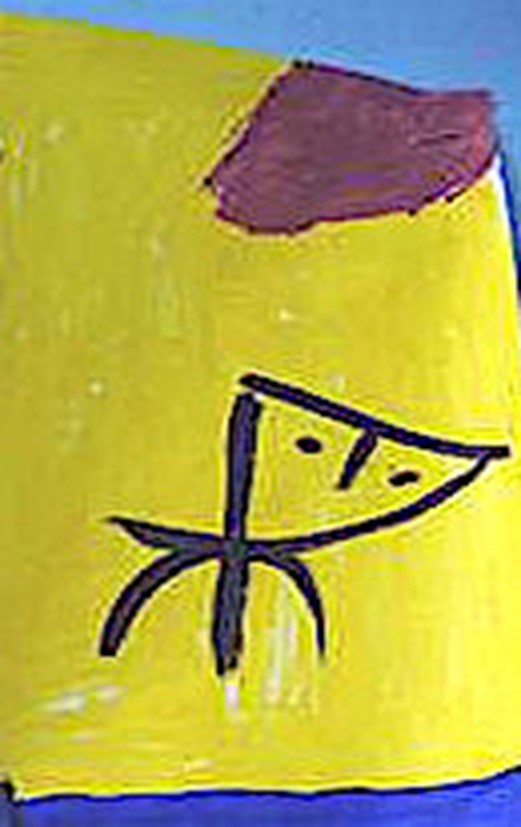
Figure 1. A child’s drawing of Miró’s cat
To extend the activity, the teacher asks: How does this picture make you feel? This question helps children connect visual choices with emotional interpretation and shows them that images communicate feelings as well as information.
Connecting Anthony Browne with René Magritte. This creative task links Anthony Browne’s Voices in the Park (1998) with René Magritte’s La Décalcomanie (1966). In Browne’s book, everyday objects – lampposts, trees, clouds – take the shape of bowler hats, echoing one of Magritte’s most recognizable motifs. Drawing children’s attention to this connection helps them see how illustrators adapt artistic symbols to create mood, viewpoint, or emotional depth. After discussing these visual links, children create their own bowler-hat drawings (Figure 2).
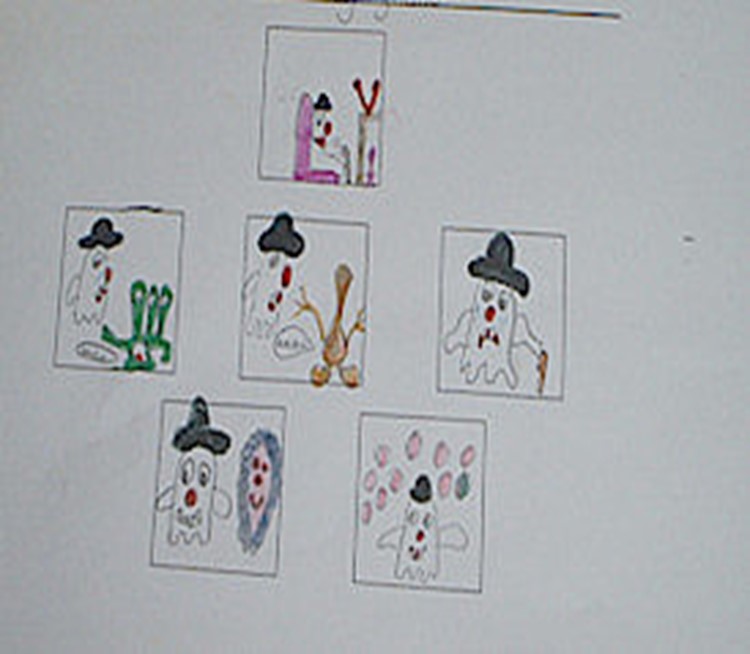
Figure 2. Spooky Ghost in a Bowler Hat
The teacher models the basic steps to draw a bowler hat:
- Draw a circle for the top of the hat.
- Add an oval underneath for the brim.
- Colour the hat black.
Once the basic shape is clear, children personalize their drawings with characters, settings, or expressive details. If their language level allows, they also write short stories inspired by their illustrations, such as Spooky Ghost in a Bowler Hat, using the bowler hat as a central element. In this way, the task supports multimodal literacy and allows children to recognize how visual elements carry meaning across texts and artistic works. At the same time, it develops English language skills through descriptive vocabulary (shapes, colours, textures), simple narrative structures, and expressive language.
Connecting Laurence Anholt with Vincent van Gogh. The picturebook Camille and the Sunflowers (1994) by Laurence Anholt introduces children to Vincent van Gogh through a gentle story that shows both his art and its emotional impact. After shared reading, educators can connect the picturebook with Van Gogh’s Sunflowers series (1888) and guide children through a slow-looking discussion focused on colour, brushstroke, texture, and composition. Through this link, children see how Anholt echoes Van Gogh’s expressive palette and curving lines and adapts them into a child-friendly visual language.
Once this visual connection is established, children create their own sunflower-inspired artworks. The aim is not to copy Van Gogh but to explore artistic techniques. To support this, materials such as plasticine, shiny paper, or layered collage give children opportunities to work with texture, depth, and colour contrast and to develop fine motor skills and personal expression.
From a language-learning perspective, the activity builds vocabulary for colours, shapes, and textures, as well as descriptive words like bright, thick, curvy, and smooth. For older grades or more advanced English learners, the same activity can extend to higher‑level visual‑arts vocabulary, terms such as contrast, composition, perspective, foreground/background, symmetry, or abstraction, which support more precise description and interpretation. As the final step, children explain their artistic choices, which strengthens expressive communication and links what they see with what they say. Taken together, this dialogic process reflects multimodal literacy: children move between close attention to images, verbal exchange, and hands‑on artistic work, which deepens their understanding of how meaning is made across different modes.
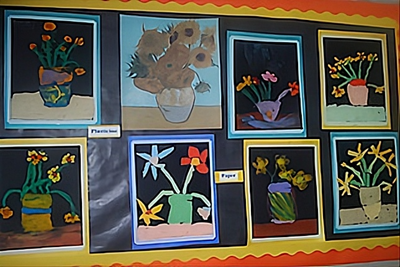
Figure 3. A class mural inspired by Van Gogh’s sunflowers
A classroom mural of children’s sunflower creations in paper and plasticine fosters aesthetic awareness, encourages shared learning, and shows how collective artwork supports visual and classroom interaction (Figure 3).
Connecting Ian Falconer with Edgar Degas. In Olivia (2000), Ian Falconer creates this link when the protagonist sees Edgar Degas’s Swaying Dancer, Dancer in Green (1887–1889) during a museum visit. Through this encounter, children expand their visual and cultural knowledge by meeting familiar artistic techniques and references rather than starting visual literacy from scratch. At the same time, Falconer adapts Degas’s impressionistic style in ways that introduce visual strategies not typically found in contemporary picturebook illustration, which broadens children’s interpretive possibilities. Building on this connection, a slow-looking discussion invites children to compare Falconer’s ballerinas with Degas’s dancers. Following this discussion, they take part in the creative practice: Sponge printing ballet dancers. Figure 4 shows an example of a child’s artwork titled Swaying Dancer, inspired by Edgar Degas’s painting.
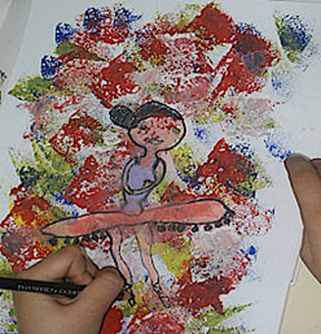
Figure 4. Swaying Dancer
Using a small sponge, children create textured backgrounds that echo the softness and colour blending in Degas’s paintings. Through this technique, they explore colour, layering, and texture while also develop fine motor control skills. To carry out the task, children follow these steps:
- Dip a small piece of sponge into paint and gently press it onto paper to create textured patterns.
- Repeat the process with different colours and shapes to build an impressionistic background.
- Once the paint dries, draw a ballet dancer on top of the printed surface.
From a language-learning perspective, the activity supports vocabulary related to colour, movement, texture, and emotion, as well as descriptive structures such as soft, light, swirly, in the background, or in the corner. As the activity progresses, children explain their artistic choices or describe their dancers, which strengthens oral fluency and expressive language. Taken together, the dialogic nature of the activity aligns with multimodal and cultural literacy principles where learners interpret visual cues, verbalise their observations, and connect their creative work to broader cultural references and artistic practices.
Connecting Nina Laden with Henri Matisse. Nina Laden’s When Pigasso Met Mootisse (1998) introduces children to the art of Pablo Picasso and Henri Matisse through humour and playful visuals. Beyond this initial introduction, the story expands children’s ability to interpret images by exposing them to ideas and techniques from modern art. In the case of Henry Matisse, the book offers a simple way to explore his late cut-out style, evident in works like Panel with Mask (1947), and helps educators show how artists use positive and negative shapes and simplified forms to communicate meaning.
Building on this foundation, a slow-looking discussion that compares Laden’s illustrations with Matisse’s cut-outs helps children notice how different artistic practices use abstraction, composition, and colour to express ideas. This comparison also opens space to talk about cultural heritage and how modern art influences the images children encounter today. Once these connections are clear, children make their own abstract artworks using both the shapes they cut out and the leftover stencils. This hands-on stage lets them explore how shape and space interact while they try out composition, layering, and colour. Figure 5 illustrates this process: a child first painted the background green, then cut out various shapes, and finally arranged and glued both the positive and negative stencils to produce a striking composition.
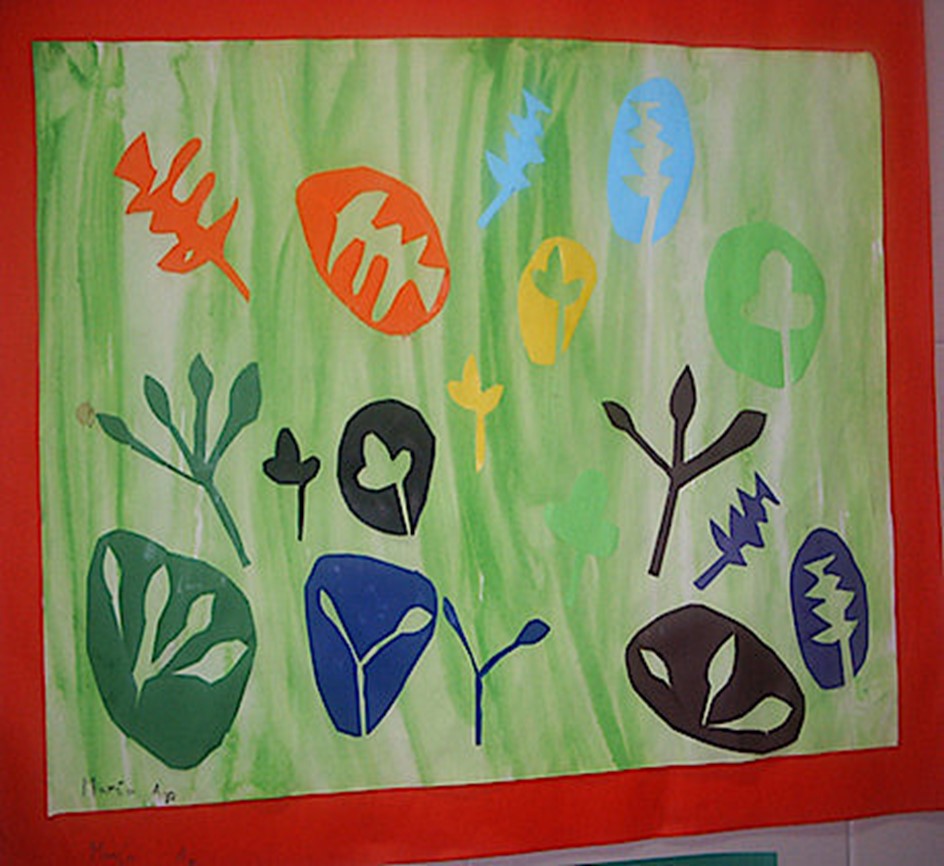
Figure 5. Positive and negative cutting-out paper
Taken together, this activity promotes visual literacy and creative expression, develops fine motor skills, and supports English language learning through vocabulary related to colours, shapes, textures, and materials. In addition, it introduces process language (first I painted… then I cut… finally I glued…). Moreover, the activity strengthens multimodal and cultural literacy by encouraging children to look closely, share their observations, and connect their artwork to wider artistic practices.
Discussion
Exploring the artistic ecosystems of picturebooks shows how illustrations and fine art connect. In particular, when picturebooks make allusions to fine-art paintings or artistic styles, they create intertextual connections that mediate access to artistic concepts and invite children to explore visual meaning. Such intertextual connections promote deep looking, shared interpretation, and dialogic learning approaches (Berger, 1972; Kress & van Leeuwen, 2020; Serafini, 2015; Alexander, 2020).
From an artistic perspective, picturebooks that draw on fine-art paintings or artistic styles help children imagine, create, and engage with wider cultural themes. Moreover, hands-on projects, such as creating artworks inspired by painters like Miró, Degas, or Matisse, allow children to experiment with artistic processes and strengthen their visual literacy skills. When used regularly in the classroom, these activities promote holistic learning (Hubard, 2007).
From a linguistic perspective, fine-art connections during read‑alouds also support English language development. When children describe visual elements, they learn new vocabulary and practice using it as they talk about images. Dialogic learning presents talk as a tool for thinking, mediating children’s language development through interaction with visual art (Alexander, 2020). Through this dialogic exchange (asking and answering questions, making comparisons, and giving reasons) children build both conceptual understanding and expressive skills.
By highlighting links between picturebooks and fine art and suggesting ways to use them during classroom talk, this article explains how these texts support visual, linguistic, art-making, and cultural development. Ultimately, picturebooks that engage with fine art connect traditional literacies with visual and multimodal literacies and help children develop competencies for the 21st century (Serafini, 2015).
Conclusion
Integrating picturebooks that allude to fine art into classroom practice enriches children’s learning by treating images as cultural texts that mediate interpretation, dialogue, and creative response. In particular, when authors and illustrators allude to the paintings or artistic techniques of well‑known artists, they create richer visual stories. This helps children recognize how colour, line, composition, and texture shape meaning. As a result, this intertextual dimension strengthens visual literacy by exposing learners to artistic elements that extend beyond those typically found in contemporary picturebook illustrations.
Picturebooks inspired by fine art support interdisciplinary learning that links language, art, and culture. In addition, shared reading, slow looking, and hands‑on artwork offer children chances to explore artistic conventions and to develop language through description, reasoning, and expressive communication. When teachers attend to the formal and cultural dimensions of images with the same care they give to written text, they help children foster ‘the intelligence of the eye’ (Raschka, 1998).
For English language development, talk about art provides natural opportunities to learn and use vocabulary related to colour, shape, emotion, movement, and perspective. In this context, the description of what children see, the comparison of artistic choices, and the explanation of interpretations help them practise rich language structures that expand both comprehension and expression. Because visual images clarify meaning, young learners can articulate more complex ideas and participate more confidently in classroom dialogue. Grounded in dialogue rather than specialized background knowledge, this approach suits diverse multilingual classrooms and supports children’s visual, cultural, and linguistic development.
Pedagogically, these implications highlight the value of treating picturebook illustrations not as decorative additions but as central texts for meaning-making. Consequently, picturebooks inspired by fine art encourage teachers to design learning experiences that combine visual analysis, cultural exploration, and language development in ways that strengthen one another. Such practices broaden children’s cultural awareness, deepen their engagement with texts, and situate their learning within a wider cultural landscape. Ultimately, work with picturebook illustrations and fine art equips learners with the visual and multimodal skills they need to become attentive observers, confident communicators, and imaginative thinkers.
Bibliography
Anholt, Laurence (1994). Camille and the sunflowers. Barron’s Educational Series.
Anholt, Laurence (2003). The Magical Garden of Claude Monet. Frances Lincoln Children’s Books.
Browne, Anthony (1986). Piggybook. Julia MacRae Books.
Browne, Anthony (1989). The Tunnel. Julia MacRae Books.
Browne, Anthony (1998). Voices in the Park. Doubleday.
Browne, Anthony (2000). Willy’s Pictures. Walker Books.
Burgess, Matthew, illus. Josh Cochran (2020). Drawing on walls: A story of Keith Haring. Enchanted Lion Books.
Crane, Walter (1898). Little Red Riding Hood [Illustration]. In Walter Crane’s Picture Books. John Lane.
Cressy, Judith (2002). Can you find it? Abrams Books for Young Readers.
D’Aquino, Andrea (2019). A life made by hand: The story of Ruth Asawa. Princeton Architectural Press.
De la Peña, Matt, illus. Christian Robinson (1996). Milo imagines the world. G.P. Putnam’s Sons.
Dodds, Dayle Ann, illus. Julie Lacome (2020). The Shape of Things. Candlewick Press.
Elschner, Geraldine, illus. Peggy Nille (2012). The Cat and the Bird: A Children’s book inspired by Paul Klee. Prestel Publishing.
Elschner, Geraldine, illus. Florence Koenig (2018). Anna and the artist. A Children’s Book Inspired by Jan Vermeer. Prestel Junior.
Falconer, Ian (2000). Olivia. Atheneum Books for Young Readers.
Garland, Michael (1995). Dinner at Magritte’s. Dutton Children’s Books.
Harman, Alice, illus. Quentin Blake (2020). Mona Lisa and the Others. Thames & Hudson.
Isadora, Rachel (2000). 1 2 3 Pop! Viking Books for Young Readers.
Khalsa, Dayal Kaur (1987). I Want a Dog. Tundra Books.
Laden, Nina (1998). When Pigasso met Mootisse. Chronicle Books.
Le Tord, Bijou (1999). A Bird or Two: A Story About Henri Matisse. Eerdmans Books for Young Readers.
Liu, Joanne (2018). My Museum. Penguin Random House.
Luyken, Corinna (2017). The Book of Mistakes. Dial Books for Young Readers.
Maclear, Kyo, illus. Julie Morstad (2019). It began with a page: How Gyo Fujikawa drew the way. HarperCollins.
Marshall, James (1972). George and Martha. Clarion Books.
Massenot, Veronique, illus. Élise Mansot (2011). Journey on a Cloud. Prestel Publishing.
Mayhew, James (2014). Katie’s Picture Show. Orchard Books.
McDonnell, Patrick. (2006) Art. Little, Brown and Company.
Micklethwait, Lucy (1992). I spy: An alphabet in art. Greenwillow Books.
Micklethwait, Lucy (1993). I spy two eyes: Numbers in art. Greenwillow Books.
Micklethwait, Lucy (1994). I spy a lion: Animals in art. Greenwillow Books.
Micklethwait, Lucy (1996). I spy shapes in art. Greenwillow Books.
Micklethwait, Lucy (1996). I spy a freight train: Transportation in art. Greenwillow Books.
Percy, Graham (1994). Arthouse. Chronicle Books.
Perrault, Charles, illus. Walter Crane (1875). Little Red Riding Hood. George Routledge and Sons.
Pinkney, Jerry (2009). The Lion and the Mouse. Little, Brown and Company.
Raczka, Bob (2003). More than meets the eye. Lerner Publishing Group.
Simmonds, Posy (1988). Lulu and the Flying Babies. Random House Children’s Books.
Shopsin, Tamara, illus. Jason Fulford (2019). Art This Way. Phaidon Press.
Van den Ende, Peter (2020). The Wanderer. Levine Querido.
Vere, Ed. (2023). The artist. Doubleday Books for Young Readers.
Waldman, Neil (1999). The Starry Night. Boyds Mills Press.
Walsh, Ellen Stoll (2007). Mouse shapes. Harcourt Children’s Books.
Zolotow, Charlotte (1962). Mr. Rabbit and the Lovely Present. HarperCollins.
Referenced Artworks
Chagall, Marc (1939). The bridal pair with the Eiffel Tower [Oil on canvas]. Private collection.
Degas, Edgar (1877–1879). Swaying Dancer (Dancer in Green) [Pastel on paper]. Museo Nacional Thyssen-Bornemisza, Madrid, Spain.
Goya, Francisco (1791–1792). The Straw Manikin [Oil on canvas]. Museo Nacional del Prado, Madrid, Spain.
Hals, Frans (1624). The Laughing Cavalier [Oil on canvas]. Wallace Collection, London, UK.
Hockney, David (1967). A Bigger Splash [Acrylic on canvas]. Tate Britain, London, United Kingdom.
Klee, Paul (1928). Cat and bird [Oil and ink on paper mounted on cardboard]. Museum of Modern Art, New York, United States.
Leonardo da Vinci (1503–1519). Mona Lisa [Oil on poplar panel]. Louvre Museum, Paris, France.
Lowry, Laurence Stephen (1943). July, the Seaside [Oil on canvas]. Arts Council Collection, Southbank Centre, London, United Kingdom.
Magritte, René (1966). La Décalcomanie [Oil on canvas]. Museo Magritte, Brussels, Belgium.
Matisse, Henry (1947). Panel with Mask [Gouache on paper, cut and pasted]. Museum of Modern Art, New York, NY, USA.
Miró, Joan. (1951) Le petit chat au clair de la lune [Lithograph]. Yale University Art Gallery, New Haven, CT.
Monet, Claude-Oscar (1914–1917). Irises [Oil on canvas]. National Gallery, London, UK.
Monet, Claude-Oscar (1914–1926). Water Lilies [Oil on canvas]. Museum of Modern Art, New York, NY, USA.
Picasso, Pablo (1942). Sitting Woman with a Fish Hat [Oil on canvas]. Stedelijk Museum, Amsterdam, Netherlands.
Renoir, Pierre-Auguste (1881–1886). Les Parapluies [Oil on canvas]. National Gallery, London, UK.
Seurat, Georges-Pierre (1884–1886). A Sunday afternoon on the island of La Grande Jatte [Oil on canvas]. Art Institute of Chicago, Chicago, IL, USA.
Van Gogh, Vincent (1886). Three Pairs of Shoes [Oil on canvas]. Fogg Museum, Harvard Art Museums, Cambridge, MA, United States.
Van Gogh, Vincent (1887). Sunflowers [Oil on canvas]. The Metropolitan Museum of Art, New York, United States.
Van Gogh, Vincent (1888). The Bedroom [Oil on canvas]. Van Gogh Museum, Amsterdam, Netherlands.
Van Gogh, Vincent (1889). Irises [Oil on canvas]. J. Paul Getty Museum, Los Angeles, United States.
Van Os, Jan (1777–1778). Fruit and Flowers in a Terracotta Vase [Oil on wood]. The National Gallery, London, United Kingdom.
Vermeer, Johannes (c. 1657–1658). The Milkmaid [Oil on canvas]. Rijksmuseum, Amsterdam, Netherlands.
References
Alexander, R. (2020). A dialogic teaching companion. Routledge. https://doi.org/10.4324/9781351040143
Arizpe, E., & Styles, M. (2015). Children Reading Pictures: Interpreting Visual Texts (2nd ed.). Routledge.
Bateman, J. A. (2014). Text and image: A critical introduction to the visual/verbal divide. Routledge. https://doi.org/10.4324/9781315773971
Beckett, S. (2010). Artistic allusions in picturebooks. In T. Colomer, B. Kummerling-Meibauer, & C. Silva-Diaz (Eds.), New directions in picturebook research (pp. 83–98). Routledge.
Berger, J. (1972). Ways of seeing. Penguin Books.
Browne, A. (2004). Interview with TeachingBooks. Retrieved from https://school.teachingbooks.net/interview.cgi?a=1&id=7
Callow, J. (2008). Show me: Principles for assessing students’ visual literacy. The Reading Teacher, 61(8), 616–626. https://doi.org/10.1598/RT.61.8.3
Cameron, L. (2001). Teaching languages to young learners. Cambridge University Press.
Gass, S. M., & Selinker, L. (2008). Second language acquisition: An introductory course (3rd ed.). Routledge.
Housen, A., & Yenawine, P. (2000). Visual Thinking Strategies: Understanding the basics. Visual Understanding in Education.
Hubard, O. M. (2007). Complete engagement: Embodied response in art museum education. Art Education, 60(6), 46–56. https://doi.org/10.1080/00043125.2007.11651133
Kress, G., & van Leeuwen, T. (2020). Reading images: The grammar of visual design (3rd ed.). Routledge.
Lambert, M. D. (2015). Reading picture books with children: How to shake up storytime and get kids talking about what they see. Charlesbridge.
Lewis, D. (2001). Reading Contemporary Picturebooks: Picturing Text. Routledge.
Lightbown, P. M., & Spada, N. (2013). How Languages are Learned (4th ed.). Oxford University Press.
Machado, J. M. (2015). Early Childhood Experiences in Language Arts: Early Literacy (11th ed.). Cengage Learning.
Moebius, W. (2017). Six degrees of closeness in the picture book experience: Getting closer. In N. Hamer, P. Nodelman and M. Reimer (Eds.), More words about pictures (pp. 30–43). Routledge.
Nikolajeva, M., & Scott, C. (2000). The Dynamics of Picturebook Communication. Routledge.
Nodelman, P. (1988). Words about Pictures: The Narrative Art of Children’s Picture Books. The University of Georgia Press.
Pollard-Durodola, S.D., Simmons, D. C., Gonzalez, J.E., and Simmons, L.E. (2015). Accelerating Language Skills and Content Knowledge through Shared Book Reading. Brookes Publishing.
Prain, V., & O’Brien, J. (2000). The role of picture books in the development of literacy. In K. A. Roskos & J. F. Christie (Eds.), Play and literacy in early childhood: Research and practice (pp. 123–138). Lawrence Erlbaum Associates.
Raschka, C. (1998). 32 pages and a chipmunk; Or what is appropriate art for children? Book Links, 7(4), 36.
Roche, M. (2015). Developing Children’s Critical Thinking through Picturebooks A Guide for Primary and Early Years Students and Teachers. Taylor and Francis.
Salisbury, M., & Styles, M. (2012). Children’s picturebooks: The art of visual storytelling. Laurence King.
Sipe, L. R. (2001). Using picturebooks to teach art history. Studies in Art Education, 42(3), 197-213. https://doi.org/10.1080/00393541.2001.11651698
Serafini, F. (2015). The appropriation of fine art into contemporary narrative picturebooks. Children’s Literature in Education, 46(4), 438–453. https://doi.org/10.1007/s10583-015-9246-2
Serafini, F. (2024). The complex relationship of words and images in picturebooks. Journal of Visual Literacy, 43(3), 233–249. https://doi.org/10.1080/1051144X.2024.2394338
Tavin, K. (2021). Visual culture and education. Routledge. https://doi.org/10.4324/9780429020932
Tiballi, A. (2020). Cultural heritage education in early childhood: Approaches and perspectives. International Journal of Early Childhood, 52(3), 265–280. https://doi.org/10.1007/s13158-020-00275-4
Valleau, M. (2016). Artistic traditions and visual storytelling in contemporary picturebooks. Journal of Children’s Literature, 42(1), 28–36.
Xue, M., & Beckett, G. H. (2021). Intertextuality and cultural representation in children’s picturebooks: Pedagogical implications for global education. Children’s Literature in Education, 52(4), 345–362. https://doi.org/10.1007/s10583-020-09432-9
Yanawine, P. (2013). Visual Thinking Strategies: Using Art to Deepen Learning across School Disciplines. Harvard Educational Publishing Group.
Yohlin, E. (2012). Pictures in pictures: Art history and art museums in children’s picture books. Children’s Literature in Education, 43(3), 260-272.
Yokota, J., & Teale, W. H. (2011). Materials in the school reading curriculum. In T. V. Rasinski (Ed.), Rebuilding the foundation: Effective reading instruction for 21st century literacy (pp. 66–87). Solution Tree Press.