

| Ordinary Magic in the Classroom: Promoting Perspective-taking and Resilience through Challenging Picturebooks
Barbara Katharina Reschenhofer |
Download PDF |
Abstract
This article investigates the social-emotional potential of reading ‘challenging picturebooks’ (Ommundsen et al., 2021) for promoting resilience and critical literacy skills in the English language and literature classroom. Drawing on interdisciplinary research on bibliotherapy, the developmental benefits of social-emotional learning, and successful classroom interventions for stress inoculation, the preventive effects of multimodal reading experiences are illustrated and discussed. The concept of Ordinary Magic (Masten, 2001) is used to further demonstrate in how far challenging picturebooks, in particular, can be used as springboards for critical conversations about mental and emotional well-being, perspective-taking, and emotion regulation in an educational context. Recommendations for suitable readings and evidence-based suggestions for reflective learning tasks in early English language education are provided.
Keywords: young reader resilience, perspective-taking, refugee picturebooks, bibliotherapy, trauma-informed practice
Barbara Katharina Reschenhofer is Assistant Professor in English for Academic Purposes at Maynooth University. She obtained her PhD in English and American Studies at the University of Vienna. Reschenhofer’s research interests include critical literacies, social-emotional learning, multimodal analysis, and learner development in early childhood and adult education.
Introduction
In a world that is growing increasingly complex and, at times, unpredictable when it comes to geo-political conflict and natural disasters, expectations for the individual to stay resilient in the face of uncertainty while mastering every-day academic, vocational, and interpersonal skills too are on the rise. Unlike adults, children seldom have the wherewithal to comprehend and reflect on adversity in a way that would help them regulate the negative emotions accompanying these experiences. While indispensable support resources for children certainly exist, these are predominantly provided to at-risk demographics or to those who have already lived through a traumatic event. Young readers who are not deemed at-risk or in need of targeted social-emotional support are often introduced to challenging picturebooks with the primary aim of developing their empathy for vulnerable peers (e.g., Barnyak & Myers, 2024; Kucirkova, 2019; Zapata et al., 2017). In light of this, this article discusses the many other benefits of reading complexly themed picturebooks for young learners and suggests using these as a means to preventively microdose resilience into the English language and literature classroom. By identifying parallels between a selection of challenging picturebooks and the materials used in bibliotherapy as well as trauma-informed, school-based interventions that promote resilience in young learners (e.g., Higgen, 2022; Hains, 1992; Wolmer et al., 2011), I make suggestions for a wider-reaching promotion of social-emotional competencies and multimodal literacy in the English language classroom.
Research on the development of children’s resilience suggests that the processes involved in promoting optimism and confidence are far less complicated than one might expect. Ann S. Masten (2001), who is a prominent expert on child development and resilience, defines such processes as ‘Ordinary Magic’ (p. 227), as they predominantly entail rather transparent notions. Key components of Ordinary Magic for instance include: ‘connections to competent and caring adults in the family and community, cognitive and self-regulation skills, positive view of self, and motivation to be effective in the environment’ (Masten 2001, p. 234; see also Garmezy, 1985; Luthar et al., 2000; Masten et al., 1990; Masten & Coatsworth, 1998; Masten & Reed, 2002; Wyman et al., 2000).
Resilience is often considered a trait that one synchronously acquires as obstacles and hardships are overcome. Research from the field, though, suggests that resilience can be fostered even before a significant adverse event occurs in a child’s life (Karapetian Alvord & Johnson Grados, 2005, p. 240; see also Masten & Coatsworth, 1998). For instance, growing up in a secure household where primary caregivers are emotionally available and physically present is an early indicator that the child in question will show higher levels of resilience in youth and adulthood (Karapetian Alvord & Johnson Grados, 2005, p. 240; see also Contreras et al., 2000). Positive influences on an individual’s ability to display resilience are generally known as ‘protective factors’ (Karapetian Alvord & Johnson Grados, 2005, p. 239), and, according to the literature (e.g., Masten, 2021, p. 119), agency, connectedness, and hope are among the most crucial protective factors for a human being or system.
Scholars who examine human responses to adversity predominantly conclude that resilience in children can be evaluated on the basis of their achievements in developmental tasks, among other factors (Godor et al., 2024; Masten, 2021, p. 118). Concrete examples for such developmental tasks include forming secure attachment to caregivers, attending school, becoming literate, or abiding by explicit and implicit social rules in communities and society at large (Masten, 2021, p. 118). This basic maxim of resilience research thus makes the close links between resilience, social-emotional competencies, and academic skills more than evident.
Due to their, usually, prolonged and regular presence in a young child’s life, teachers play a key role in overseeing such developmental tasks and facilitating social-emotional learning (SEL) in the classroom (Barnyak & Myers, 2024, p. 1423; Lucas & Soares, 2013, p. 138). Through SEL, learners of all age ranges ‘acquire and apply the necessary knowledge and skills to understand and manage emotions, set goals, show empathy for others, establish positive relationships, and make responsible decisions’ (Elmi, 2020, p. 849; see also CASEL, 2020; Reicher, 2010). SEL thus closely aligns with the processes described by Masten (2001, p. 227). Whether a child has already been affected by a traumatic event or not, education and play that incorporate elements of Ordinary Magic and SEL can positively impact their holistic development (Hua et al., 2025, p. 7). For this reason, it would make sense for teachers to microdose resilience-promoting exercises into the general English language and literature classroom by focusing on language and social-emotional competencies simultaneously (Barnyak & Myers, 2024, p. 1424) rather than exclusively reserving the latter for at-risk or special-circumstance learner groups.
In terms of language learning, the goal might be what Mary Roche (2015), citing Chall et al. (1990), describes as a ‘critical transition period in children’s literacy ability’ (p. 66), namely the shift when a young learner no longer learns to read but reads to learn. Reading to learn, in a SEL context, translates to reading to learn more about oneself and others while simultaneously strengthening general literacy skills, learning resilience, and task management (Hua et al., 2025, pp. 5–7; Barnyak & Myers, 2024). Though vocabulary acquisition and other aspects of language development still remain intended learning outcomes in an SEL-informed picturebook discussion, the act of reading expands into a means of nurturing curiosity and inspiring transformative classroom discussions, where critical reflection and spontaneous speech production take precedence over accuracy and controlled practice (Fleta, 2019, p. 247; Barnyak & Myers, 2024, p. 1424).
Letters from Fictional Friends
Research on bibliotherapy and classroom interventions that promote resilience has shown how the engagement with literature about challenging topics can serve to equally support children who have already experienced significant trauma on one hand as well as help young learners in developing a protective sense of resilience against potential future adversity on the other. Bibliotherapy is a popular pedagogical concept and intervention among scholars and educators, wherein thematic books are selected for classroom readings with the goal of promoting literacy while simultaneously teaching problem-solving skills, emotion regulation, and a tolerance for change and ambiguity (Aziz et al., 2025; Cancino & Buitrago Cruz, 2019; Lucas & Soares, 2013). Bibliotherapy has been described as a suitable and effective approach for learners of all ages, backgrounds, and language levels. For instance, Cancino and Buitrago Cruz (2019) report on the benefits of bibliotherapy for young adult language learners who have experienced trauma related to violence and displacement (p. 99), while Lucas and Soares (2013) focus on classroom interventions for children in a wider context and emphasize the importance of preventive resilience (p. 138).
Not dissimilar to the bibliotherapeutic approach, some stress inoculation interventions for children have been reported to combine themed stress inoculation training (SIT) sessions with correspondingly themed reading material. For example, an intervention design by Guido Veronese and Gianpiero Barola (2018) uses storytelling as a means of empowerment for children affected by war, and highlights both advantages and risks of such interventions for children suffering from severe trauma. Similarly, a controlled SIT study by Leo Wolmer, Daniel Hamiel, and Nathaniel Laor (2011) describes the effectiveness of preventive interventions that use fictional narratives and critical reflection strategies, among other exercises, to encourage young learners, living in or close to a war zone, to read, talk, and think about complex events, concepts, and emotions.
What makes Wolmer et al.’s (2011) study particularly relevant to the present discussion of the potential of picturebooks is their employment of a specific pedagogical-literary device – namely letters from a fictional character named Adam. These letters are read, reflected on, and discussed in a classroom setting. Comparably to how refugee protagonists in picturebooks about flight may tell readers about their struggles and hardships, Adam writes letters about unpleasant experiences, negative thoughts, games, friendship, as well as other themes and topics which may too be found in ‘challenging picturebooks’ (Ommundsen, 2021): ‘Through his letters, Adam shares with the students his experiences and skills learned, legitimizing and verbalizing complex feelings. Adam also guides the children and proposes activities to practice and internalize newly acquired skills’ (Wolmer et al., 2011, p. 343).
Closely aligning with SEL’s focus on emotional competencies and bibliotherapy’s thematic approach, Wolmer et al.’s (2011) classroom interventions too run according to dedicated themes. In a session entitled ‘Breathing and processing unpleasant experiences’ (p. 348.e1), the corresponding letter covers Adam’s own adverse experiences. A session on violence is accompanied by a letter of Adam’s about stress and aggression. Another session on ‘The power of communication’ (p. 348.e1) features a letter about the importance of listening (Wolmer et al., 2011, pp. 348.e1-348.e2). An autodiegetic picturebook, which is a picturebook wherein the protagonist is also the narrator, can perhaps be viewed as a long narrative letter to the reader. In such a text, the narrator shares their story, thoughts, and feelings in the same way fictional pen pal Adam does (see Sivashankar, 2024, p. 15).
Challenging Picturebooks about Forced Displacement
The topic of forced displacement in picturebooks comprises a particularly suitable genre for the thematic exploration of challenging narratives, as these texts commonly focus on matters that may be relatable to children both with and without first-hand flight experience. Lucas and Soares (2013, p. 137–138) point out that emotions of anger, anxiety, adjusting to new environments, finding friends, as well as the unfortunate but not uncommon instances of death or divorce in the family can affect the academic and social development of a child at school who would perhaps not necessarily be classified as at-risk or in need of specific emotional support. For this reason, the benefits of resilience-promoting and preventive pedagogies for children of any background or circumstance should not be ignored. The following sections will illustrate how select texts from challenging genres – such as picturebooks about displacement – might be used for a thematic exploration of critical literacy and emotional expression in the English language classroom.
Finding words for complex emotions in Ali’s Story
One concrete example for a suitable picturebook that can be employed in a similar way to Adam’s letters is Maldonado and Glynne’s Ali’s Story (2015). In the text, protagonist Ali tells the reader about his personal experiences with adversity and negative emotion: ‘I dreamt about them [Ali’s parents] all the time and I cried every night. It was like the bones in my body were broken […] Sometimes I felt angry, but most of the time I felt really sad’ (Maldonado & Glynne, 2015, unpaginated). Offering a very intimate and vivid account of the fictional character’s innermost feelings, this double-spread (see Figure 1) can be used as a springboard for critical discussions about complex emotions and how one might effectively regulate them in times of distress.
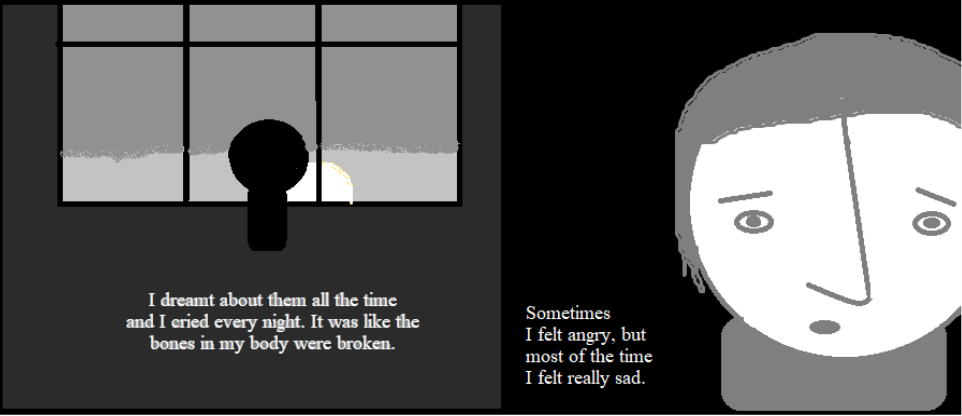 Figure 1. A sketch-like appropriation of a double-spread from Ali’s Story, in black and white. The depicted protagonist Ali autodiegetically narrates his adverse experiences and negative emotions.
Ali here expresses emotional pain (grief) through comparison to physical injury (broken bones). This provides a language model to young readers how emotions that they may not have the vocabulary for can be expressed otherwise. The intentional distinction between sadness and anger on this spread moreover exemplifies the nuance and plurality of negative emotion. Acquiring and poignantly using vocabulary in this way is crucial for the development of both language and social-emotional skills. In order to discuss the contents of a complex picturebook, or the nuances of one’s emotions, a specific set of words, phrases, and sometimes even idioms will be required. A common consensus among scholars appears to be that new vocabulary is not acquired by simply reading alone or reading aloud. Rather, it is the interaction around reading that helps learners adopt a wider lexical range (Roche, 2015, p. 68; see also Biemiller & Boote, 2006). For instance, an educator reading Ali’s Story in class could elicit from the young pupils what else deep emotional pain might be comparable to.
According to Roche (2015), children with a limited vocabulary range find less enjoyment in reading, which in turn means less exposure to new and varied vocabulary items (p. 66; see also Moats, 2020, p. 3 cited in Manzone & Conant, 2015). Picturebooks are thus suitable for both enthusiastic and less enthusiastic readers, as their multimodal nature makes them visually stimulating and arguably less daunting than more wordy texts. Multimodal children’s literature also relies on its reader(s) to bring it to life through interactions before, during, and after an often non-linear joint reading session. Joint readings, also called read-alouds, of challenging picturebooks in the English language classroom can thus not only promote receptive and critical thinking skills, but they can also help learners improve ‘their expressive language’ (Roche, 2015, p. 66) by introducing specific vocabulary for nuanced emotions – as modelled by an autodiegetic narrator such as Ali.
The fact that language shapes one’s perception of reality has been widely discussed and studied in depth (Devitt & Sterelny, 1999). The wider the range of vocabulary for various emotional states a child possesses, the better able they will be to express their own feelings when necessary. For young learners in particular, learning to use language in context is crucial for a deeper understanding of how meaning is rarely rigid but in fact dynamic and, at times, ambiguous. As aptly put by Devitt and Sterelny (1999): ‘Each time the child changes the system, [everything changes]. Language learning cannot be represented as a cumulative process’ (p. 266). Ali’s comparison of grief to physical injury exemplifies how language use can be contextual and dynamic. This is precisely where interactive readings of picturebooks add value to language and literacy development; non-linear joint readings invite young learners to pause, reflect, and interject with questions, comments, and observations about strange or relatable events and emotions.
Other themes tackled in Ali’s Story include the uncertainty of growing up in an unsafe place, parent-child separation, settling into a strange new environment, as well as the power of optimism and hope for a better future. Problem-solving, optimistic thinking, and perspective-taking play a key role in forging resilience in early years (Karapetian Alvord & Johnson Grados, 2005, p. 241; Masten, 2001; Masten, 2021). Mary Karapetian Alvord and Judy Johnson Grados (2005) recommend to ‘[t]each children and families problem-solving skills to identify controllable and uncontrollable circumstances and adversities’ (p. 241) and, drawing on prior studies, further emphasize the importance of asking children questions that ‘encourage them to generate alternatives and options’ (Karapetian Alvord & Johnson Grados, 2005, p. 241; see also Bloomquist, 1996). Allowing a young reader to practice problem-solving and perspective-taking in class not only instils confidence in their ability to think and act with control and agency, but it also serves as an opportunity for the child to engage with adversity as something that can be overcome rather than something that can only be passively endured.
Problem-solving and taking control in My Name is Not Refugee
Picturebooks like Kate Milner’s My Name is Not Refugee (2017) implicitly invite readers to actively think about situations that are either within or outside of one’s control. Questions and thinking prompts are already incorporated into the narrative. The picturebook begins with a young boy telling the reader what his mother had said to him about what it would mean to embark on a journey of flight. From the first double-spread, the boy narrates the picturebook in future tense, recounting his mother’s words of what she anticipates will happen during the flight. ‘Shall I tell you what it will be like?’ (Milner 2017, unpaginated), the reader is asked. The boy thus becomes to the reader what his own mother is to him – a gentle authority on the topic of displacement, addressing someone who supposedly has not yet but might experience similar hardship. Such ‘questions to get the dialogue started’ (Roche, 2015, p. 63) can allow young readers to engage with the text more freely and autonomously, as the questions are asked by the contextualized, autodiegetic child narrator rather than the extradiegetically-positioned classroom teacher.
Into almost every spread Milner’s My Name is Not Refugee incorporates critical thinking or problem-solving prompts which invite the reader to imagine themselves alongside the protagonist. For instance, on a double-spread where the child narrator announces: ‘[w]e’ll have to say goodbye to old friends’ (Milner, 2017, unpaginated), a small blue box of text at the bottom of the page asks: ‘What would you take?’. Next to the blue box there is an illustration of the protagonist’s backpack with a teddy bear and other personal belongings. What My Name is Not Refugee here presents to the young reader is a situation that is out of the autodiegetic narrator’s control – their displacement from home. What still remains within their control, however, is the decision over what to take on their journey away from home. The prompt reassures young readers that they still might find ways to claim and retain agency even in the most unfamiliar scenarios – an agency that can be fostered through Ordinary Magic in the classroom (see Masten, 2021).
As the narrative in My Name is Not Refugee progresses, prompts become longer and more specific, for instance: ‘Do you think you could live in a place where there is no water in the taps and no one to pick up the rubbish?’ (Milner, 2017, unpaginated). Such questions can help spark classroom conversations about how young students may consider navigating situations they otherwise would not have imagined finding themselves in. If the readers should have to face comparable adverse scenarios in the future, they will benefit from having previously imagined their behavioural and emotional responses to such a scenario. Studies like Wolmer et al.’s (2011) suggest that mental preparation and imagination can play a crucial role in stress inoculation for future crisis management, notably reducing the negative toll on the child.
Children who find themselves in perhaps less life-threatening but nevertheless emotionally challenging situations will likewise benefit from the resilience they have proactively fostered, scaffolded by teachers who intently incorporate protective factors into the learning environment. In Milner’s picturebook, further prompts invite the reader to reflect on present circumstances and feelings. For instance, ‘Can you speak more than one language?’ and ‘What things would remind you of your old home?’ (Milner, 2017, unpaginated) focus on the child’s competencies and internal resources – tools they already carry within them or, in the case of learners of English or other languages, skills they are actively working on at school.
Autodiegetic pictures in My Beautiful Birds and Far From Home
Across other picturebooks, such as Suzanne Del Rizzo’s My Beautiful Birds (2017) or Sarah Rubio Parker and Fátima Anaya’s Far From Home (2019), readers will moreover find what Perry Nodelman calls autodiegetic pictures (1991, p. 7). Autodiegetic pictures are illustrations that are focalized through the autodiegetic narrator – so the reader, for a moment, beholds a scene through the eyes of the narrating protagonist. In My Beautiful Birds (2017), for instance, an autodiegetic picture of a bird on paper, painted by the protagonist, spans across an entire double-spread. The reader beholds the drawing in front of them, as though they had just finished creating it themselves. The drawing in question is one of a pigeon, smeared and partially ruined by black paint. The verbal narration reads: ‘I tear my painting piece by piece. Black paint stains my hands and my clothes’ (Del Rizzo, 2017, unpaginated). This scene represents the protagonist’s conflicting emotions of missing his pet pigeons back home in pre-war Syria. The reader is invited to step into and explore the perspective of the traumatized protagonist as he grapples with intense negative emotion and thereby learns how emotions that cannot be expressed through language can be alternatively expressed through art.
In Far From Home, an autodiegetic picture is used to help the reader take on the perspective of a young refugee protagonist who has to leave behind his home and treasured childhood toys. A verso page depicts the image of three stuffed animals smiling at the reader. The verbal narrative reads: ‘These used to be my toys’ (Parker Rubio & Anaya, 2019, unpaginated). In beholding the protagonist’s toys staring at the reader, it is as though we are in the protagonist’s bedroom, about to choose but one toy to bring along on an uncertain journey of our own. Autodiegetic pictures like those featured in Far From Home and My Beautiful Birds can aid perspective-taking and encourage curious enquiry in the English language and literature classroom, as other characters and actions are often removed from such scenes, thus briefly shifting the focus from the protagonist’s experience onto the reader’s. In this way occasional autodiegetic illustrations allow for the reader to feel more immersed into the narrative than scenes would typically allow for (Wyile, 2001).
Narration and third-person self-characterization
Teachers may also want to encourage young learners to take on the role of the verbal narrator in addition to reading fictionalized letters or texts. A 2020 study by Guido Veronese and Federica Cavazzoni examined how displaced minors responded to trauma through being engaged in multimodal self-characterizing tasks. What stands out about these tasks, which draw on a framework designed by George A. Kelly (1991), is that the teachers instruct the children to write about themselves in the third person. The 2020 study found that children affected by deeply traumatic events display more resilience and ‘abundant sources of functioning, coping abilities and agency’ (Veronese & Cavazzoni, 2020, p. 51) than one might expect. Taking ownership of a sense of agency, hope, and positive self-view directly aligns with Masten’s (2021) Ordinary Magic as well as the indicators of positive resilience development mentioned in the literature (Karapetian Alvord & Johnson Grados, 2005).
Recommendations by Veronese and Cavazzoni (2020) include interventions that focus less on pathologizing negative emotions and more on the empowerment of displaced and oppressed children as active agents ‘within a community that is engaged in resisting oppression and humiliation’ (p. 61). When given the opportunity to self-characterize in the third person, children are able to express a desired self-image as agents, heroes even, rather than victims by default (p. 52, p. 60; Friese, 2017). What these insights thus suggest is that children, despite tragedy and adversity, are instinctively capable of honing Ordinary Magic (see Masten, 2001) as a coping mechanism. In a classroom of pupils who predominantly have not endured comparable trauma, perspective-taking activities that encourage both autodiegetic story-telling and third-person characterization can invite young learners to tap into these instincts early.
Activities and Tasks to Inspire Ordinary Magic in the Classroom
Picturebooks like Ali’s Story, My Name is Not Refugee, Far From Home, and My Beautiful Birds effectively use multimodal strategies, such as autodiegetic pictures or visual-verbal constructions of human emotion, to convey complex concepts and feelings to young readers. These texts touch on themes of varying gravity, ranging from finding friends at a new school to coping with grief at home. Informed by a bibliotherapeutic approach and inspired by the benefits of SEL as well as successful implementations of trauma-informed classroom interventions that employ fictional narratives, teachers might design classroom activities that directly engage with the protagonists and themes from challenging picturebooks. Depending on the learners’ age ranges, needs, and English language proficiency levels, classroom tasks may focus on reading, writing, speaking, drawing, and/or other means of expression. Table 1 below offers suggestions, informed by the research discussed in this article, for classroom tasks that combine language learning with social-emotional competencies and critical literacy development:
| Reading to learn | Reading a picturebook as a long letter from a fictional friend (joint read-aloud, led and contextualized by the teacher).
Reading short, multimodal letters focalized through a picturebook’s protagonist (individual reading task, following the joint read-aloud of the corresponding picturebook). |
| Problem-solving | Orally responding to prompts in/about the narrative during a joint read-aloud (e.g.: What would you do? Could you ask someone for help in English?). |
| Writing and drawing for reflection | Writing and/or responding to a letter for/to the protagonist (empathizing & problem-solving).
Drawing a postcard for the protagonist (Imagination and perspective-taking). Characterizing/describing oneself in third person (self-characterization in writing and drawings). |
| Naming themes and emotions | Identifying and describing the themes of a selected picturebook.
Comparing intangible emotions to tangible feelings (grief || broken bones). Describing the difference between related emotions (anger vs. sadness). (These three tasks can first be done orally, during a joint read-aloud, and later re-visited individually or through pairwork in a worksheet exercise). |
| Perspective-taking | Drawing an autodiegetic picture from the perspective of a given picturebook’s narrator.
Describing the autodiegetic picture to a peer (naming emotions, explaining and reflecting on creative choices). |
Table 1. Suggestions for reflective classroom tasks in the English language classroom.
With the goal in mind to guide learners toward a reading-to-learn mindset (see Roche, 2015, p. 66), young readers could be incentivized to explore narratives that are presented as long-form letters from a fictional friend or peer. Texts like Ali’s Story lend themselves particularly well to this approach. Alternatively, the teacher could prepare a short and more accessible letter, focalized through a given picturebook’s protagonist, and hand out copies of this letter after a joint reading of the original text. These short letters would ideally be multimodal in design and invite pupils to notice, remember, and reflect on key themes, details – and with that also key vocabulary – mentioned in the respective picturebook.
Texts like My Name is Not Refugee use and model the use of prompts that can spark critical classroom conversations. Reflective prompts not only engage learners in a non-linear and therefore more dynamic reading of a given picturebook, but they also enable children to practise problem-solving and empathizing. Special attention might be paid to prompts that emphasize certain language skills as a key advantage in real-life scenarios, as this can motivate learners to practise their English, for instance in role-play activities that simulate these very scenarios (e.g., arriving at a new school where the other pupils only speak English).
Depending on the learners’ age ranges, solving problems and expressing confidence can moreover be fostered through reflective writing tasks. Pupils can assume agency and take on a role as either the supportive friend writing to the protagonist or, through third person characterization, assume the role of a protagonist and imagine how others might perceive and describe them. In addition to giving learners practice in productive skills, such tasks function to promote agency, connectedness, and confidence, thus directly aligning with Masten’s (2021) concept of Ordinary Magic.
What texts like Ali’s Story and My Beautiful Birds vividly convey are their respective protagonists’ struggles with complex negative emotion. In both narratives, the boy protagonists struggle with grief, sadness, and anger but ultimately find hope for a better future. Teachers can use these or similar picturebooks to help learners not only identify and name different emotions but also demonstrate alternative ways to describe intangible emotions when the child does not yet have the precise vocabulary to explicitly name them. Equally, learners can be equipped with the language necessary to identify and describe themes found in the picturebooks that are closely linked to Masten’s (2021) Ordinary Magic. Relevant vocabulary for common themes may thus include loss, separation, friendship, family, home, change, and hope.
Picturebooks like My Beautiful Birds and Far From Home follow young protagonists who remain connected to the homes they have lost through memories of the familiar. By pausing to behold and reflect on autodiegetic images, the reader is invited to step into the protagonist’s shoes in each text. In the classroom, language learners could be invited to perspective-taking in a similar way, by creating relevant narrative or autodiegetic drawings of their own (see Bland, 2023, p. 107–108). Pairing a creative task with free fluency practice (e.g., telling peers about their drawings) re-shifts the focus from language learning to organic communication (Fleta, 2019; Roche, 2015).
Lastly, an important consideration is the integration of thematic picturebook readings into the existing curriculum and aligning text selection with the cohorts’ respective developmental stages (Sun et al., 2025, p. 14). Bibliotherapeutic approaches that promote critical literacies are recommended as continuous practices over the course of a child’s development rather than reserved for a one-off, set timeframe in the school year (Hope, 2017; Lucas & Soares, 2013, p. 142). In an initiative to promote awareness and empathy for those affected by forced displacement for example, many schools across Ireland and the UK host Refugee Day or Refugee Week (UNHCR, 2017; Refugee Week, 2026). Though these events certainly can leave a lasting impression on young developing minds, the topics they broach should not be kept out of the regular syllabus by default. Whether the aim is to promote empathy for others or resilience within oneself, the better advice is to continuously and thematically engage young learners in social-emotional and global topics across the span of their entire school education.
It should be noted that picturebooks about displacement only represent one of many niche genres that can be introduced into the English language and literature classroom. Medical picturebooks or environmental picturebooks also offer rich material to facilitate organic classroom discussions and scaffold language learning through thematic exploration (Cad et al., 2022; Li et al., 2025; Sun et al., 2025; Wang & Zhao, 2024; Woodard & Beauchemin, 2025).
Conclusion and Discussion
As teachers maintain regular, close contact with their learners on a near-to daily basis, they are in a unique position to notice when a pupil might struggle with one or more developmental tasks. By combining elements of bibliotherapy with social-emotional learning strategies and incorporating these into the English language and literature classroom, teachers can support their learners in developing critical developmental skills in addition to linguistic competencies.
What educators might adopt from a social-emotional and trauma-informed approach is the use of themes to structure classroom readings of autodiegetic narratives as well as what Wolmer et al. (2011) refer to as ‘a gradational mix of reality (teacher’s instructions) and imagination (Adam’s letters), on which children are invited to reflect critically’ (p. 343). Reading challenging picturebooks, in this way, has the potential to benefit diverse readerships, ranging from readers who might have already experienced or will potentially experience traumatic events first-hand to those who may only come into contact with such adversity indirectly. Classroom tasks and supplementary materials, linked to the chosen picturebooks, should be designed to meet the learners’ English proficiency levels and language learning needs and suit their contexts.
As suggested by the literature, children possess an instinct for hope and optimism, agency and problem-solving, and human connection (Veronese & Cavazzoni, 2020). By monitoring their cohorts’ formative and continuous learning within a pedagogical framework that actively encourages critical literacy and social-emotional learning, educators may witness how young learners organically co-create Ordinary Magic (Masten, 2001, p. 227; Masten, 2021) when engaging with the tasks such as the recommended classroom activities offered in this article. Books which broach topics like displacement, homelessness, separation, death, loss, or war can, despite their challenging themes, be read to elicit feelings of hope rather than pessimism, inspiration rather than pity, and empowerment rather than helplessness.
Bibliography
Del Rizzo, Suzanne. (2017). My Beautiful Birds. Pajama Press.
Maldonado, Salvador, & Andy Glynne. (2015). Ali’s Story. Wayland.
Milner, Kate. (2017). My Name is Not Refugee. The Bucket List.
Parker Rubio, Sarah, & Fátima Anaya. (2018) Far From Home. Tyndale Kids.
References
Aziz, R. A., Saman, W. S. W. M., Shaifuddin, N., & Radzi, S. M. (2025). Bibliotherapy features in children’s literature: A systematic literature review. Journal of Information Knowledge Management, 15(1), 109–120.
Barnyak, N., & Myers, J. M. (2024). Picturebooks about disasters: Incorporating interactive read-alouds to support young children’s social-emotional learning. Early Childhood Education Journal, 52, 1423–1432. https://doi.org/10.1007/s10643-023-01523-6
Biemiller, A. & Boote, C. (2006). An effective method for building meaning vocabulary in primary grades. Journal of Educational Psychology, 98, 44–62. https://doi.org/10.1037/0022-0663.98.1.44
Bland, J. (2023). Compelling Stories for English Language Learners: Creativity, Interculturality, and Critical Literacy. Bloomsbury.
Bloomquist, M. L. (1996). Skills Training for Children with Behavior Disorders. Guilford Press.
Cad, A. C., Liruso, S., & Requena, P. E. (2022). Integrating environmental awareness in ELT through picturebooks. Children’s Literature in English Language Education, 10(2), 98–118.
Cancino, E. M. R., & Buitrago Cruz, C. P. (2019). Exploring the use of bibliotherapy with English as a Second Language Students. English Language Teaching, 12(7), 98–106. https://doi.org/10.5539/elt.v12n7p98
CASEL (Collaborative for Academic, Social, and Emotional Learning). (2025). What is SEL? Retrieved March 16, 2026, from https://casel.org/what-is-sel/
Chall, J. S., Jacobs, V.A. & Baldwin, L. E. (1990). The Reading Crisis: Why Poor Children Fall Behind. Harvard University Press.
Devitt, M., & Sterelny, K. (1999). Language and Reality: An Introduction to the Philosophy of Language. MIT Press.
Elmi, C. (2020). Integrating social emotional learning strategies in Higher Education. European Journal of Investigation in Health, Psychology and Education, 10, 848–858. https://doi.org/10.3390/ejihpe10030061
Fleta, T. (2019). Picturebooks: An effective tool to encourage children’s English L2 oral production. TEANGA, 10, 243–261. https://doi.org/10.35903/teanga.v10i0.81
Friese, H. (2017). Representations of gendered mobility and the tragic border regime in the Mediterranean. Journal of Balkan and Near Eastern Studies, 19(5), 541–556. https://doi.org/10.1080/19448953.2017.1296260
Garmezy, N. (1985). Stress-Resistant Children: The Search for Protective Factors. In J. E. Stevenson (Ed.), Recent Research in Developmental Psychopathology. Pergamon Press.
Godor, B. P., van der Horst, F. C. P., & van der Hallen, R. (2024). Unravelling the roots of emotional development: Examining the relationships between attachment, resilience and coping in young adolescents. Journal of Early Adolescence, 44(4), 429–457. https://doi.org/10.1177/02724316231181876
Hains, A. A. (1993). A stress inoculation training program for adolescents in a high school setting: A multiple baseline approach. Journal of Adolescence, 15(2), 163–175. https://doi.org/10.1016/0140-1971(92)90045-7
Higgen, S, Mueller, J. T., & Moesko, M. (2022). Review: Universal mental health interventions for young students in adverse environments – a systematic review of evaluated interventions. Child and Adolescent Mental Health, 27(3), 281–293. https://doi.org/10.1111/camh.12493
Hope, J. (2017). Children’s Literature About Refugees: A Catalyst in the Classroom. UCL Institute of Education Press.
Hua L, Zhang, Z., & Wang, H. (2025). How social–emotional learning promotes reading achievement? A systematic review of mechanisms and instructional design. Frontiers in Psychology, 16,1631429, 1–10. https://doi.org/10.3389/fpsyg.2025.1631429
Karapetian Alvord, M., & Johnson Grados, J. (2005). Enhancing resilience in children: A proactive approach. Professional Psychology, Research and Practice, 36(3), 238–245, https://doi.org/10.1037/0735-7028.36.3.238
Kelly, G. A. (1991). The Psychology of Personal Constructs. Routledge.
Kucirkova, N. (2019). How could children’s storybooks promote empathy? A conceptual framework based on developmental psychology and literary theory. Frontiers in Psychology, 10, 1–15, https://doi.org/10.3389/fpsyg.2019.00121
Li, C., Q. Chen, Zhuang, X., Wu, Y., & Hu, R. The effectiveness of picture books on reducing preoperative anxiety in children: A systematic review and meta-analysis of randomized controlled trials. Journal of Clinical Nursing, 34(8), 3406–3416. https://doi.org/10.1111/jocn.17747
Lucas, C. V., & Soares, L. (2013). Bibliotherapy: A tool to promote children’s psychological well-being. Journal of Poetry Therapy, 26, 137–147. https://doi.org/10.1080/08893675.2013.823310
Luthar, S. S., Cicchetti D., & Becker, B. (2000). The construct of resilience: A critical evaluation and guidelines for future work. Child Development, 71(3), 543–562. https://doi.org/10.1111/1467-8624.00164
Manzone, J. & Conant, A. (2025). Beyond the Page: Transformative Social Emotional Learning Through Picture Books. In J. Tussey & L. Haas (Eds.), Supporting Linguistic Differences Through Literacy Education. (pp. 99–130). IGI Global Scientific Publishing. https://doi.org/10.4018/979-8-3373-3496-7.ch004
Masten, A. S. (2001). Ordinary Magic. Resilience Processes in Development. The American Psychologist, 56(3), 227–238. https://doi.org/10.1037//0003-066x.56.3.227
Masten, A. S. (2021). Resilience in developmental systems. In M. Ungar (Ed.), Multisystemic Resilience (pp. 113–134). Oxford University Press. https://doi.org/10.1093/oso/9780190095888.003.0007
Masten, A. S., Best, K. M., & Garmezy, N. (1990). Resilience and development: Contributions from the study of children who overcome adversity. Development and Psychopathology, 2(4), 425–444. https://doi.org/10.1017/S0954579400005812
Masten, A. S., & J. D. Coatsworth. (1998). The development of competence in favorable and unfavorable environments: Lessons from successful children. American Psychologist, 53(2), 205-220. https://doi.org/10.1037/0003-066X.53.2.205
Masten, A. S., & Reed, M. J. (2002). Resilience in Development. In C. R. Snyder & Shane J. Lopez (Eds.), The Handbook of Positive Psychology. (pp. 74–88). Oxford University Press.
Moats, L. C. (2020). Teaching reading is rocket science. What expert teachers of reading should know and be able to do. American Federation of Teachers. https://www.aft.org/sites/default/files/moats.pdf
Nodelman, P. (1991). The Eye and the I: Identification and First-Person Narratives in Picture Books. Children’s Literature, 19, 1–30. https://doi.org/10.1353/chl.0.0494
Ommundsen, Å. M., Haaland, G. & Kümmerling-Meibauer, B. (2021). Exploring Challenging Picturebooks in Education: International Perspectives on Language and Literature Learning. Routledge. https://doi.org/10.4324/9781003013952
Refugee Week. (2025). Refugee week at your school. Retrieved March 16, 2026, from https://refugeeweek.org/refugee-week-at-your-school/
Reicher, H. (2010). Building inclusive education on social and emotional learning: Challenges and perspectives: A review. International Journal of Inclusive Education, 14, 213–246. https://doi.org/10.1080/13603110802504218
Roche, M. (2015). Developing children’s critical thinking through picturebooks: A guide for primary and early years students and teachers. Routledge.
Sivashankar, N. (2024). ‘Tell Pebble all about it’: Displacement and distancing in contemporary picturebooks about Arab refugees. Bookbird, 62(1), 13–21. https://doi.org/10.1353/bkb.2024.a918613
Sun, C., Hussain N., & Ghafar, A. A. (2025). Relationship between natural environment theme picture book design and children’s cognitive development: A systematic review. Cogent Arts & Humanities, 12(1), 1–17. https://doi.org/10.1080/23311983.2025.2451499
UNHCR (United Nations High Commissioner for Refugees). (2017). World Refugee Day 2017 – Children’s book list: Read a book about refugees. Retrieved March 16, 2026, from https://www.unhcr.org/ie/sites/en-ie/files/legacy-pdf/58e37f3a4.pdf
Veronese, G., & Barola, G. (2018). Healing stories: An expressive-narrative intervention for strengthening resilience and survival skills in school-aged child victims of war and political violence in the Gaza Strip. Clinical Child Psychology and Psychiatry, 23(2), 311–332. https://doi.org/10.1177/1359104518755220
Veronese, G., & Cavazzoni, F. (2020). ‘I hope I will be able to go back to my home city’: Narratives of suffering and survival of children in Palestine. Psychological Studies, 65(1), 51–63. https://doi.org/10.1007/s12646-019-00502-5
Wang, Z., & Zhao, Y. (2024) Application study of interactive picture books in alleviating the fears of medical experience among pediatric patients. In C. Stephanidis, M. Antona, S. Ntoa, & G. Salvendy (Eds.), Communications in Computer and Information Science: HCI International 2024 Posters (pp. 388–395). Springer.
Wolmer, L., Hamiel D., & Laor, N. (2011). Preventing children’s posttraumatic stress after disaster with teacher-based intervention: a controlled study. Journal of the American Academy of Child and Adolescent Psychiatry, 50(4), 340–348.e2. https://doi.org/10.1016/j.jaac.2011.01.002
Woodard, R., & Beauchemin, F. (2025). Exploring child-nature-city relations through ecocritical readings of a diverse environmental picturebook. English Teaching: Practice & Critique, 24(3), 205–219. https://doi.org/10.1108/ETPC-04-2025-0073
Wyile, A. S. (2001). First-person engaging narration in the picture book: verbal and pictorial variations. Children’s Literature in Education, 32(3), 191–202.
Wyman, P. A., Sandler, I., Wolchik, S., & Nelson, K. (2000). Resilience as cumulative competence promotion and stress protection: Theory and intervention. In D. Cicchetti, J. Rappaport, I. Sandier, & R. P. Weissberg (Eds.), The Promotion of Wellness in Children and Adolescents (pp. 133–184). Child Welfare League of America Press.
Zapata, A., Fugit, M., & Moss, D. (2017). Awakening socially just mindsets through visual thinking strategies and diverse picturebooks. Journal of Children’s Literature, 43(2), 62–69.