

| Turning Pages into Living Stories: Supporting Narrative Retelling and Early English Language Use through Elmer
Klara Jurić |
Download PDF |
Abstract
David McKee’s Elmer picturebooks formed the basis of a year-long series of teaching sequences involving picturebook read-alouds, picture sequencing, guided retelling and spatial retelling with pre-primary children learning English in Croatia. I investigated how the children used linguistic and multimodal resources to construct narratives during these activities. The study involved 23 children in their second year of English learning. I analysed transcripts of picture-based retellings by three purposively selected focal children whose use of English differed in extent and form. I collected audio-recorded retellings and contemporaneous observational notes during the preschool year. I considered narrative sequencing and organization, the use of English and Croatian, responses to teacher scaffolding, and participation through gesture, pointing, movement, and physical materials. October and May provided the closest comparison because both retellings used the same story. Later retellings showed greater narrative elaboration in two focal cases and a somewhat broader range of English words in all three, while Croatian and multimodal support remained important. During spatial retelling, the children also shared narrative responsibilities through speech, movement, objects, and peer coordination.
Keywords: early English language learning, picturebooks, pre-primary education, narrative retelling, spatial retelling
Klara Jurić is a pre-primary educator mentor at Kindergarten Trnsko in Zagreb, Croatia. Her professional interests include early English language learning, the arts, and storytelling with picturebooks.
Introduction
Picturebooks create narrative meaning through the interaction of verbal and visual modes (Nodelman, 1988; Nikolajeva & Scott, 2001). Narančić Kovač (2015) describes narrative picturebooks as forms of dual verbal and visual narration, while more recently Narančić Kovač and Novaković (2026) explore the picturebook’s interrelated verbal and visual discourses. Bland (2023) highlights that in English language education, such multimodality is important because images can support understanding, prompt inference and anticipation, and give young language learners ways into a story before they can express the same meanings in English.
Similarly in pre-primary English education, children may understand and respond to a story through resources that exceed what they can currently express in English. Mourão’s (2021) study with Portuguese pre-primary English learners shows children drawing on their linguistic repertoires to interpret sequential images in a wordless picturebook. Her later account of picturebooks and reading aloud locates mediation across the choice of the picturebook, the read-aloud itself, and the children’s responses (Mourão, 2022). Looking, listening, talking, gesture, movement, and the use of more than one language can all contribute to narrative meaning-making.
This emphasis on participation also fits wider directions in pre-primary language education. For example, in their review of 74 empirical studies published between 2000 and 2022, Nikolov and Mihaljević Djigunović (2023) call for greater attention ‘towards the whole child’ (p. 451). And Prošić-Santovac and Savić (2022) similarly emphasize pedagogies that respond to the developmental characteristics of children aged three to six. In Croatia, these principles are compatible with the National Curriculum for Early Childhood and Preschool Education (Ministry of Science, Education and Sport, 2015), which foregrounds exploration, play, social interaction, and children’s active participation. Story-based, play-oriented, and interaction-rich approaches offer a natural connection between these early-childhood principles and English language education (Mourão & Ellis, 2020).
I considered the children’s engagement with picturebooks beyond the read-aloud through repeated narrative reconstruction. Familiar Elmer stories were revisited through picture sequencing, guided retelling, and play, enabling the children to return to a shared storyworld while changing how they took part in telling it. I use ‘spatial retelling’ to refer to the reconstruction of a narrative within a three-dimensional play space through the positioning and movement of characters, props, and other story-related materials. I asked: How did the children use linguistic and multimodal resources when Elmer stories were revisited through picture sequencing, guided retelling, and spatial retelling during a preschool year? I analysed transcripts of the three focal children’s picture-based retellings and used observational notes to describe participation in the spatial-retelling activities.
Theoretical Framework
Scaffolded retelling and participation
Retelling involves more than recall as children need to select and connect events, identify characters and actions, and draw on recurring language as they reconstruct a story. Repeated encounters can change what participation looks like. Ellis and Brewster (2014) observe that ‘repetition also encourages participation in the narrative’ (p. 7), a principle reflected in the children’s repeated encounters with selected Elmer stories and their engagement in recurring classroom practices of picture sequencing, guided retelling and play.
I understand scaffolding as responsive assistance that enables the children to sustain their retellings when they encounter linguistic or narrative difficulties. In practice, this involved modelling, repetition, questioning, translation and prompting, which I adapted as the children became more familiar with the stories and retelling routines. Mourão and Ellis (2020) emphasise the importance of routines, visual and material resources, embodied activity and interaction in pre-primary English pedagogy. Drawing on these principles, I considered how changes in my scaffolding practices shaped the children’s participation and their growing responsibility for telling stories.
Linguistic and multimodal repertoires
I approached the children’s use of Croatian and English as part of the same process of narrative meaning-making. Mourão’s (2015) study of repeated picturebook read-alouds shows young language learners combining resources from the languages available to them, and her study of a wordless picturebook similarly documents the use of linguistic repertoires alongside sequential images (Mourão, 2021). Likewise, in the present study, the children drew on Croatian to sustain and elaborate their retellings while incorporating English words, short expressions and emerging stretches of sentence-level language.
The children’s participation extended beyond speech as gestures, pointing, visual references, movement, and the manipulation of objects sometimes carried information that remained implicit in their spoken language. I therefore consider spoken contributions alongside these visible and material resources, with English production understood as one aspect of a broader process of participation.
Play, embodiment, and participation
In spatial retelling, the children went beyond arranging or describing illustrations to reconstruct the stories in a three-dimensional play space. They positioned and moved characters and objects, coordinated actions with peers, and used the materials to represent narrative events. Mourão (2014) captures the tension between adult planning and child direction, observing that ‘even if they plan for children’s play, they cannot plan children’s play’ (p. 256). Although I designed the spatial-retelling activities, the children increasingly decided who narrated, moved characters, directed the action and organised the story materials.
The children’s decisions about narrative roles illustrate the agency Waddington (2023) associates with play, even within an activity whose materials and initial structure I had planned. Anatoli’s (2025, pp. 6–7) study of a Swedish–English preschool similarly highlights the importance of embodied activity and teacher support for young children’s participation. In the storytelling activity, the children gradually assumed greater responsibility, moving from responding to my prompts towards coordinating their actions with peers. This development can be understood through Lave and Wenger’s (1991) theory of situated learning, which emphasises participation in shared social practices.
Methodology
Research design and context
I conducted the classroom-based qualitative study within an early English language learning programme in a Croatian pre-primary group. During one preschool year, I developed teaching sequences that moved from picturebook read-alouds and picture sequencing towards guided and spatial retelling with play materials. The group comprised 23 children aged three to five who were in their second year of English language learning. English sessions took place daily for approximately 30 minutes, with picturebook-focused activities two to three times each week. I was both the children’s teacher and the researcher throughout the study.
Participants and focal cases
All 23 children participated in the picturebook activities. For the detailed transcript analysis, I purposively selected three focal children whose retellings represented contrasting patterns in the amount and forms of English used during picture-based retelling. At the first data collection point, L.R. was aged 3 years 11 months, I.R. 4 years 2 months and G.K. 4 years 1 month. The three cases offered different examples of how the children used their available linguistic resources within the same broad teaching sequences.
Teaching sequences and materials
The teaching sequences centred on David McKee’s Elmer picturebook series, selected for its distinctive visual narratives, recurring characters, and themes accessible to young children, including friendship, difference, belonging, helping others, and cooperation. Sessions usually began with dialogic read-alouds in which I read the stories in English and used Croatian translation or clarification when the children needed help understanding the story or participating. I initially focused on visually salient and familiar vocabulary, including colours, shapes, animals, and settings. As the children became familiar with the stories and retelling routines, I introduced language associated with actions and movement and, during spatial retelling, spatial relationships such as up/down, left/right, near/far, and in front of/behind.
The activities incorporated the original English-language picturebooks, picture-sequencing materials, and three-dimensional story props, including representations of Elmer and Wilbur and other elements reconstructed from the narratives. The three-dimensional materials were created collaboratively by the children, parents/carers, and me. Earlier retellings involved more modelling, repetition, translation, and structured questioning. Later activities left greater room for the children to guide the retelling, take on storytelling roles, and coordinate the materials themselves.

Figure 1. Three-dimensional models of Elmer and Wilbur

Figure 2. Set props based on the stories
Data collection
I collected data at three points during the 2024–2025 preschool year: October, January, and May. The main dataset comprised audio-recorded picture-based retellings, which I transcribed, together with contemporaneous observational notes. The recordings captured the children’s spoken contributions alongside my prompts during the retelling activities. The story stimuli varied across the three collection points as the October and May retellings used illustrations from Elmer (2007), while the January retelling used Elmer and the Lost Teddy (1999). A subsequent January sequencing activity used illustrations from Elmer and Rose (2008). I therefore consider the three collection points as complementary qualitative samples. The October and May samples provide the closest comparison because the children worked with the same story. The spatial-retelling findings draw on contemporaneous observational notes, while the detailed linguistic analysis draws on the systematically transcribed picture-based retellings. The observational notes inform the analysis of participation, role-taking, movement and the use of materials.
Analytical approach
I read the transcripts and accompanying observational notes repeatedly, comparing the three focal cases and the three collection points. I looked for recurring patterns and contrasts in how the children organized story events, used English and Croatian, responded to modelling and prompts, and combined speech with gesture, pointing, movement, and physical materials. I used the five analytical foci in Table 1 to compare the focal cases and collection points.
| Analytical focus | What was examined |
| Narrative sequencing and organization | Ordering and connecting events; identifying characters, actions, and intentions; maintaining a recognizable storyline. |
| Use of English | Story-related words and short expressions; emerging clauses or sentence-level stretches used to contribute to the narrative. |
| Use of linguistic resources | Movement between Croatian and English; use of Croatian to sustain or elaborate the narrative while English resources were emerging. |
| Response to teacher scaffolding | Responses to modelling, repetition, translation, prompts, and structured questions; changes in the amount of support used. |
| Multimodal participation and role-taking | Gesture, pointing, visual reference, movement, and manipulation of props; narrating, moving characters, directing peers or coordinating the sequence of actions. |
Table 1. Analytical foci for narrative participation and language use
Ethical considerations
I obtained permission to conduct the study from the pre-school principal. Parents/carers provided written informed consent in Croatian for the collection of voice recordings and photographs, and the children were invited to give oral assent in Croatian before taking part in recorded storytelling activities. Participation in the recorded retellings remained voluntary, and only willing children were recorded. The audio recordings were stored on a separate drive with restricted access. In this article, the three focal children are referred to by initials only to reduce identifiability.
Findings
Picture-based retelling across the preschool year
October. At the first data collection point, the children retold Elmer (2007) from a sequence of illustrations.
L.R. (female, 3 years 11 months)
‘Ja sam imala ovu book, ali sad ju više nemam.’
[I had this book, but now I don’t have it anymore.]
‘Elmer je došo kod grožđa i posto je sivi pa ga je kiša oprala.’
[Elmer came to the grapes and became grey, and then the rain washed him.]
‘Pa su svi drugi slonovi spavali, a Elmer se micao.’
[Then all the other elephants were sleeping, and Elmer was moving.]
‘This is the jungle… slonovi su drugi bili budi i Elmer pa se on odlučio šetat kod svojih prijatelja pa su se poigrali i Elmer je jedva našo hippoa… zebru je prvu dotaknuo.’
[The other elephants were awake and Elmer, so he decided to walk to his friends, and they played, and Elmer barely found the hippo… he touched the zebra first.]
I.R. (male, 4 years 2 months)
‘Tu svi slonovi spavaju, a Elmer je budan.’
[Here all the elephants are sleeping, and Elmer is awake.]
‘Tu se Elmeru isprala boja, a tu se pretreso.’
[Here Elmer’s colour got washed off, and here he shook himself.]
‘A tu je došo kod životinja i pozdravio životinje, a tu su svi na okupu.’
[And here he came to the animals and greeted the animals, and here they are all together.]
G.K. (male, 4 years 1 month)
‘Ko je ovo? Duga Elmer… a zašto on ide u usta ovo? Zašto on sad zatvorio oči?’
[Who is this? Rainbow Elmer… and why is he putting this in his mouth? Why did he close his eyes now?]
‘Sad otvori oči, tu kiša, pa tu, pa tu, pa tu.’
[Now he opens his eyes, here rain, and here, and here, and here.]
‘Još je primio za tu, za stablo.’
[He also grabbed this, the tree.]
‘Sivi Elmer ovak da se pretvorio.’
[Grey Elmer became like this.]
‘Ovo su mu prijatelji.’
[These are his friends.]
‘Ovaj novi, veliki debeli Elmer.’
[This is a new, big, fat Elmer.]
Croatian carried most of the retelling in these initial samples and English appeared mainly through individual story-related words such as book, jungle, and hippo. The three children nevertheless constructed the story in different ways. L.R. linked several events into an extended sequence. I.R. described individual scenes while broadly maintaining their order. G.K. stayed closer to visually salient details, using questions and deictic expressions such as ‘here’ alongside the illustrations. The pictures gave all three children a way to identify characters and events even when their spoken English was brief.
January. The children retold Elmer and the Lost Teddy (1999) using a new sequence of illustrations.
L.R. (female, 4 years 2 months)
L.R.: ‘Baby elephant is… ne znam na engleskom reći kako se plače.’
[I don’t know how to say crying in English.]
Teacher: ‘Crying.’
L.R.: ‘Baby elephant is crying. Bye Elmer says mommy. Hello why is baby elephant crying? Izgubio se teddy bear.’
[The teddy bear is lost.]
‘Are baby giraffe vidjela [saw] baby elephant teddy bear? Look for baby elephant teddy bear. No, said Elmer. Are you looking for the baby elephant teddy bear? Elmer and Wilbur and walking’ (mimicking the verb with fingers). ‘Došli su do [They came to] baby elephant and they gave him a teddy bear.’
I.R. (male, 4 years 5 months)
‘Elmer je tu našo teddy beara, a Elmer je do tad dao malom bebu slonu svog medvjeda.’
[Elmer found the teddy bear here, and before that Elmer gave his own teddy bear to the baby elephant.]
‘Onda su ga Elmer i Wilbur našli i odnijeli ga malom sloniću.’
[Then Elmer and Wilbur found it and brought it to the baby elephant.]
‘But Wilbur find him, he’ (points to Elmer) ‘see him.’
‘On je čuo da on govori.’
[He heard him talking.]
‘Onda je vidio da svi imaju svoje medvjediće pa da ipak ga ide potražiti.’
[Then he saw that everyone has their own teddy bears, so he decided to look for it anyway.]
‘He was here. Tu ga je on ostavio.’
[He left it there.]
‘In the jungle. And baby elephant se plakao.’
[And the baby elephant was crying.]
‘He lost his teddy, and he’ (points to Elmer) ‘rekao evo moj medvjedića.’
[said: here is my teddy bear.]
G.K. (male, 4 years 4 months)
‘Baby elephant plače.’
[Baby elephant is crying.]
‘Bacio je svog medvjedića.’
[He threw his teddy bear.]
‘He is happy.’
‘I onda se sakrio od Elmer da će ga Wilbur uzet…’
[And then he hid from Elmer so that Wilbur would take it…]
‘I onda su skupa dali ruke teddy bear.’
[And then together they gave hands teddy bear.]
‘Elmer i Wilbur tu ti se.’
[Elmer and Wilbur are here.]
‘I onda je rekao upomoć!’
[Then he said help!]
‘Treba teddy bear.’
[He needs the teddy bear.]
All three children used both Croatian and English in January. English appeared through story-related words and short expressions including baby elephant, crying, teddy bear, look for, and happy. L.R. produced longer English sequences after teacher modelling and explicitly asked for an English word she did not know. I.R. carried much of the narrative through Croatian while inserting English words and phrases and using pointing to identify referents. G.K. combined short English expressions with Croatian clauses and references to pictured events. Across the three cases, the children’s contributions moved beyond naming characters and objects to include actions, intentions, and the central problem of the story.
Following these retellings, I introduced a further sequencing activity using six illustrations from Elmer and Rose (2008). The illustrations were presented in jumbled order on a magnetic board. Some of the children required prompts such as Who? What? and How? to organize the sequence, while their English contributions frequently centred on names of characters, settings, and visually salient elements such as jungle, tiger, lion, and river. I used these observations to inform the scaffolding in later activities.

Figure 3. Child arranging illustrations from Elmer and Rose
May. The children retold Elmer (2007) using a sequence of illustrations.
L.R. (female, 4 years 6 months)
‘Elmer patchwork elephants’ (title emphasized).
‘Neki su bili debeli, neki su bili tanki, a neki su bili prestari.’
[Some were fat, some were thin, and some were too old.]
‘Elmer je otišo jednog dana u šumu i sretnuo se našo s nilskim konjom, hippo.’
[One day Elmer went into the forest and met a hippopotamus.]
‘A tu lion, a tu giraffe, a tu zebra, a onda je se ondje brali grožđice.’
[And here lion, and here giraffe, and here zebra, and then there they picked grapes.]
‘I prefarbao se ovom bojom kojom su slonovi bili.’
[And he painted himself with the colour that the elephants were.]
‘I onda on kad su svi slonovi mirili.’
[And then when all the elephants were resting.]
‘On je plesao zato jer se u cijelu tu boju prebojao.’
[He was dancing because he painted himself in that colour.]
‘Kad je padala kiša ga je cijelog premuljala.’
[When the rain was falling, it completely washed him.]
‘To je to… ja mislim.’
[That’s it… I think.]
I.R. (male, 4 years 9 months)
‘Elmera tu nema ovo je malo krdo.’
[Elmer is not here, this is a small herd.]
‘Ovaj je visoki, ovaj je malo manji, ovaj je malo viši.’
[This one is tall, this one is a bit smaller, this one is a bit taller.]
‘Elmer je htio isprat sve boje a ne zna kako.’
[Elmer wanted to wash off all the colours but didn’t know how.]
‘Pa je našo tree sivog grožđa i onda he shake.’
[So he found a tree of grey grapes, and then he shake.]
‘Probo se obrisat u to ali nije uspio.’
[He tried to wipe himself on it but didn’t succeed.]
‘I onda su drugi elephanti zatvorili eyes, he didn’t.’
[Then the other elephants closed their eyes, he didn’t.]
‘I onda kad je došlo kiša, ona ga je isprala.’
[And then when the rain came, it washed him.]
G.K. (male, 4 years 8 months)
‘Kiša počela i onda je elephant posivio.’
[The rain started and then the elephant became grey.]
‘Ovdje su sve sive elephants, a ovdje je tree povuklo.’
[Here are all the grey elephants, and here the tree pulled.]
‘I tu su opali grožđe.’
[And here the grapes fell.]
‘A ovdje je stari elephant, a tu je tiger.’
[And here is an old elephant, and there is a tiger.]
In May, the three children combined Croatian, English and references to the illustrations in different ways. L.R. produced the most extended retelling, linking more events than in October and incorporating English labels for animals. I.R. also connected more events, inserting English nouns and a short verb phrase into predominantly Croatian narration. G.K.’s account remained comparatively brief, although it connected several events and included English words for characters and objects. All three children used a somewhat broader range of story-related English vocabulary than in October, although English continued to appear alongside Croatian.
Spatial retelling through play materials
In later spatial-retelling activities, the children used three-dimensional play materials to narrate, move characters, organize actions, and coordinate events with peers. I introduced positional language including up/down, left/right, near/far, and in front of/behind as they positioned characters in relation to one another and to places in the story space. Unlike picture sequencing, spatial retelling involved coordinating narrative events with the physical placement and movement of story elements. The first story used for spatial retelling was Elmer and Butterfly (2014) and because the activity was unfamiliar, I initially used relatively frequent prompts and modelling, including Who was there? Where did they go next? Why did it happen? and What happened in the end? I observed the children responding through combinations of speech, movement, and manipulation of the story materials.

Figure 4. Spatial retelling of Elmer and Butterfly
When I introduced Elmer and the Race (2016), I observed more differentiated roles within the activity. Some of the children contributed verbal narration, others moved characters through the story space, and others coordinated positioning or the sequence of actions. My questioning became less prominent as the children took more responsibility for directing one another and deciding what happened next. The clearest change in this phase was organizational as the children increasingly shared narrative responsibility through speech, movement, and peer coordination.
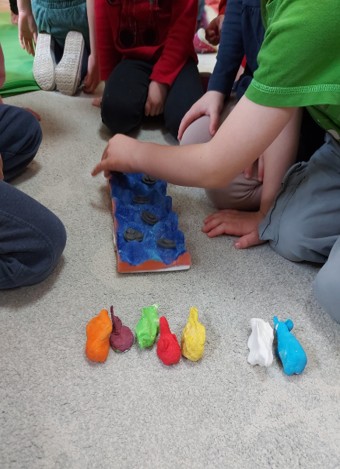
Figure 5. Spatial retelling of Elmer and the Race
Discussion
The three focal children participated in picture-based retelling in distinct ways. L.R. generally connected more events and incorporated English words and phrases into a sustained account. I.R. relied more on Croatian to establish what happened and in what order, while introducing English at particular points. G.K. remained closer to the illustrations, using questions, pointing and short expressions to identify characters and actions.
Mourão’s (2015) work on repeated picturebook read-alouds gives particular importance to the linguistic repertoires young learners bring to a story, while her later study of a wordless picturebook (2021) documents their use of language alongside sequential images. The present retellings make the contribution of Croatian especially clear. The children often used it to express temporal connections, motives and relationships between events, while English supplied character names, animal labels and, increasingly, short expressions about actions. Croatian was therefore part of the narrative work, rather than simply a means of filling gaps in English. Assessing participation solely through English production would obscure some of the coherence evident in the children’s accounts.
L.R.’s January retelling illustrates scaffolding initiated by a child’s linguistic need. When she said that she did not know how to express ‘crying’ in English, I supplied the word and she continued with ‘Baby elephant is crying’. She incorporated the new word into the narrative she was already constructing rather than merely answering a teacher-initiated question. Mourão and Ellis (2020) emphasise that young language learners can participate meaningfully in picturebook activities before producing extended English independently. In this exchange, the child initiated the request and a brief, timely response enabled her to carry on telling the story.
Visual narration remained important even when the children began using more English. As Bland (2023) argues, picturebook illustrations provide young language learners with opportunities to infer and anticipate meaning before they can express it verbally. In October, G.K.’s questions and repeated references to ‘here’ were closely tied to what was visible in the illustrations, while the other two children used the same sequence to organize more connected accounts. The illustrations supplied shared reference points, but they did not determine a single form of retelling. This variation is important in a picturebook context where verbal and visual narration contribute jointly to the construction of the story (Nikolajeva & Scott, 2001; Narančić Kovač, 2015).
The differences between the October and May retellings did not follow a uniform pattern. L.R. and I.R. connected more events in May, whereas G.K.’s retelling remained relatively brief, despite his use of a broader range of English words. Greater lexical variety did not necessarily coincide with more extended narrative organisation. Even when the children returned to the same familiar story, L.R. and I.R. organised longer event sequences while G.K. focused more closely on individual pictured details. Their narrative choices therefore differed in ways that an account of English vocabulary alone would miss.
In the picture-based recordings, one child typically narrated a sequence of illustrations, drawing on Croatian, emerging English and visual cues. Spatial retelling extended some of this narrative work into the handling of three-dimensional materials and coordination between the children. Lave and Wenger’s (1991) theory of participation in social practice helps explain this distribution of narrative responsibility, directing attention towards what the children accomplished together rather than their individual utterances.
In the Elmer spatial-retelling activity, I selected the materials and established the initial structure, but the children decided who would narrate, move characters and position props. They also directed one another in organising the sequence of events, enabling one child to contribute through physical action while another supplied the spoken narration. These decisions illustrate the opportunities for child agency within play discussed by Waddington (2023). For early English education, this suggests the value of designing storytelling activities in which children can assume responsibility for narrative decisions through speech, movement and collaboration. Teachers can then recognise how children contribute to constructing a story together, including those whose spoken language is still developing.
Limitations and directions for further research
The study involved one pre-primary group and three purposively selected focal children, so the findings are specific to this context. Although October and May used the same story, the frequency and form of my prompts varied, and January used different material. Maturation and continuing language experience may also have affected the retellings. As the teacher-researcher, I designed the activities, collected the data, and interpreted the evidence, gaining detailed contextual knowledge while also shaping the teaching situation and analysis. Spatial retelling was documented through observational notes rather than systematically transcribed recordings. Further research could use consistent story stimuli across collection points, systematic recording and transcription of spatial retelling, and collaborative or independent analysis. It would also be useful to investigate more closely how young children coordinate their different linguistic and multimodal resources when responsibility for a story is shared among classmates.
Concluding Thoughts
The three children differed in how they reconstructed the stories, drawing on Croatian, emerging English and visual resources to varying degrees. In the picture-based retellings, the children relied on Croatian to connect events while bringing English words and short expressions into their stories. Between October and May, L.R. and I.R. produced more connected narratives, whereas G.K.’s account remained brief even as he used more story-related English vocabulary. The findings therefore describe different trajectories of participation rather than a uniform progression towards longer English retellings. The spatial-retelling activities added a dimension that the individual transcripts could not capture. When the children reconstructed Elmer stories with characters and props, they distributed the telling among narration, movement, positioning and decisions made with peers. The observational notes document how they increasingly directed events and coordinated storytelling roles within these teacher-designed activities.
For pre-primary English educators, the pedagogical implication is to make room for several forms of contribution within familiar picturebook stories. Illustrations helped the children order and connect events, brief prompts supplied language when they requested it, and three-dimensional retelling enabled them to participate through actions and shared decisions as well as speech. Teachers can therefore look beyond the amount of English spoken to consider how children establish narrative coherence, request language and direct the story with their peers.
Bibliography
McKee, David (1999). Elmer and the Lost Teddy. Andersen Press.
McKee, David (2007). Elmer. Andersen Press.
McKee, David (2008). Elmer and Rose. Andersen Press.
McKee, David (2014). Elmer and Butterfly. Andersen Press.
McKee, David (2016). Elmer and the Race. Andersen Press.
References
Anatoli, O. (2025). Multimodality, embodiment, and language learning in bilingual early childhood education: Enskilment practices in a Swedish–English preschool. Learning, Culture and Social Interaction, 50, 100879. https://doi.org/10.1016/j.lcsi.2024.100879
Bland, J. (2023). Compelling stories for English language learners: Creativity, interculturality and critical literacy. Bloomsbury Academic.
Ellis, G., & Brewster, J. (2014). Tell it again! The storytelling handbook for primary English language teachers (3rd ed.). British Council.
Lave, J., & Wenger, E. (1991). Situated learning: Legitimate peripheral participation. Cambridge University Press. https://doi.org/10.1017/CBO9780511815355
Ministry of Science, Education and Sport. (2015). National curriculum for early and preschool education. Narodne novine, 5/2015.
Mourão, S. (2014). Taking play seriously in the pre-primary English classroom. ELT Journal, 68(3), 254–264. https://doi.org/10.1093/elt/ccu018
Mourão, S. (2015). Response to picturebooks: A case for valuing children’s linguistic repertoires during repeated read alouds. In S. Mourão & M. Lourenço (Eds.), Early years second language education: International perspectives on theories and practice (pp. 62–77). Routledge. https://doi.org/10.4324/9781315889948
Mourão, S. (2021). A challenging topic, format and genre: Interpreting a wordless picturebook in pre-primary English language teaching. In Å. M. Ommundsen, G. Haaland, & B. Kümmerling-Meibauer (Eds.), Exploring challenging picturebooks in education: International perspectives on language and literature learning (pp. 59–78). Routledge.
Mourão, S. (2022). Picturebooks and reading aloud in the early English language classroom. In ICEPELL Consortium (Ed.), The ICEGuide: A handbook for intercultural citizenship education through picturebooks in early English language learning (pp. 35–40). CETAPS, FCSH Universidade Nova de Lisboa.
Mourão, S., & Ellis, G. (2020). Teaching English to pre-primary children: Educating very young children. DELTA Publishing.
Narančić Kovač, S. (2015). Jedna priča – dva pripovjedača: Slikovnica kao pripovijed. ArTresor.
Narančić Kovač, S., & Novaković, N. (2026). Picturebooks between fiction and reality: An introduction. In S. Narančić Kovač & N. Novaković (Eds.), The picturebook between fiction and reality (pp. 1–32). Routledge.
Nikolajeva, M., & Scott, C. (2001). How picturebooks work. Garland Publishing.
Nikolov, M., & Mihaljević Djigunović, J. (2023). Studies on pre-primary learners of foreign languages, their teachers, and parents: A critical overview of publications between 2000 and 2022. Language Teaching, 56(4), 451–477. https://doi.org/10.1017/S0261444823000095
Nodelman, P. (1988). Words about pictures: The narrative art of children’s picture books. University of Georgia Press.
Prošić-Santovac, D., & Savić, V. (2022). English as a foreign language in early language education. In M. Schwartz (Ed.), Handbook of early language education (pp. 449–473). Springer. https://doi.org/10.1007/978-3-030-91662-6_13
Waddington, J. (2023). Early foreign language education: Play as a site for child agency. Journal of Multilingual and Multicultural Development. 1–15. https://doi.org/10.1080/01434632.2023.2290095