

| Graphic Novels and Comics for English Language Learning
Introduced by Alyssa Lowery |
Download PDF |
Graphic novels and comics have become an increasingly visible and influential presence in English language education, offering rich opportunities for meaning-making across modes. Combining visual and verbal storytelling, they invite readers to engage with narrative through image, layout, colour, and design, expanding what it means to read in the language classroom. Terminology around comics and graphic novels is not always straightforward. Rather than treating ‘comics’ as casual and ‘graphic novels’ as respectable, it can be helpful to think in the broader sense about ‘sequential art’: stories told through the arrangement of images, words, panels, and spaces. This framing bridges comics and graphic novels without placing them in a hierarchy, and it helps clarify how these texts matter for language learning. Because they ask readers to follow narratives, interpret visual cues, infer meaning between panels, and reflect on how words and images work together, they activate multimodal engagement with semiotically complex text.
Although comics and graphic novels are sometimes dismissed as ‘easy’ texts, such assumptions overlook the complexity of the form. Reading sequential art involves literacy practices that move beyond following dialogue or looking at pictures. Readers must interpret how panels, gutters, speech bubbles, facial expressions, visual perspectives, sequencing, and page design combine and contribute to meaning. As Karp (2011) argues, sequential art has its own communicative power: words and images work together in a shared visual space while readers move through text at their own pace, actively constructing meaning across the page. In this sense, graphic novels and comics do not reduce the demands of reading, but redistribute those demands across visual and verbal modes.
This redistribution is particularly valuable in English language learning contexts. For learners still developing linguistic confidence, the visual dimension of a comic or graphic novel can provide important scaffolding without removing the need for interpretation. Images support vocabulary, setting, characterization, and narrative sequence, while the relationship between image and text creates opportunity for inference, discussion, and close reading. Graphic novels are therefore not shortcuts for reading, but powerful routes into literary transaction. Research on English language learners’ reading comprehension suggests that graphic novels and comics can support understanding and motivation, with learners responding positively to the combination of visual support and narrative engagement (Aldahash & Altalhab, 2020).
Graphic novels and comics also meet young readers within a visually saturated culture. Karp (2011) notes that contemporary pupils bring a wide visual vocabulary to their classrooms, and work with visual texts can be a pedagogical and motivational asset. Rather than treating this visual fluency as separate from literacy, English language teachers can build on it. Reading a comic or graphic novel means attending to what is shown, what is said, what is left unsaid, and what happens in the spaces between panels. Such reading is interpretive, active, and can also be collaborative.
The recommendations in this issue demonstrate the breadth of what graphic novels and comics can offer across age ranges. For younger and intermediate readers, texts like Fairy Tale Comics and The Tea Dragon Society show how familiar story structures, gentle fantasy, and visually rich worlds can support language development while inviting imaginative and interpretive work. For middle-grade readers, El Deafo demonstrates how the graphic novel form can make sound, silence, embodiment, and identity visible on the page. For older readers, Laura Dean Keeps Breaking Up with Me shows how graphic storytelling can sustain emotionally and socially complex explorations of relationships, sexuality, friendship, and self-understanding. This range echoes Karp and Kress’s (2012) own age-organized approach to graphic novel collections, which emphasizes not only reading level, but also thematic content, discussion topics, and the developing interests and capacities of young readers.
Taken together, these texts remind us that graphic novels and comics are not a single type of reading experience. They can be playful, comforting, experimental, autobiographical, political, emotionally intense, or formally complex. They can support early readers and challenge advanced ones. They can provide access to language while also deepening visual literacy, critical thinking, and literary interpretation. As Richardson (2017) argues in response to the persistent idea that graphic novels are not ‘real books,’ they very much invite real reading and are motivating, demanding, and meaningful in their own right. For the English language classroom, their value lies precisely in their combination of accessibility and depth. They invite learners to read words, images, bodies, spaces, and silences together, understanding reading as an active process of meaning-making across forms.
References
Aldahash, R., & Altalhab, S. (2020). The effect of graphic novels on EFL learners’ reading comprehension. International Journal of Applied Linguistics & English Literature, 9(5), 19–26.
Karp, J. (2011). The case for graphic novels in education: Use students’ visual vocabulary as a learning tool. American Libraries Magazine, 42(7/8), 33-35.
Karp, J., & Kress, R. (2012). Graphic novels in your school library. American Library Association.
Richardson, E. M. (2017). “Graphic Novels Are Real Books”: Comparing Graphic Novels to Traditional Text Novels. The Delta Kappa Gamma Bulletin, 83(5), 24.
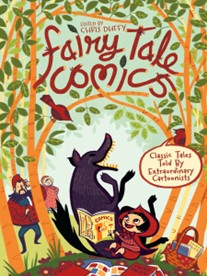
Duffy, Chris (ed.) (2013)
Fairy Tale Comics
First Second
Recommended by Alyssa Magee Lowery
Familiar stories can serve as some of the earliest entry points for language learning. With their repeated structures and wide cultural circulation, nursery rhymes and fairy tales provide learners with narrative frameworks that support comprehension as well as participation. In Fairy Tale Comics (2013), well-known stories and rhymes are reimagined by a variety of talented creators in a range of visual styles, inviting readers to engage with familiar narratives in new and multimodal ways.
When learners are already familiar with a story, the cognitive demands of reading shift. Rather than constructing meaning from unfamiliar linguistic input alone, readers can draw on prior knowledge to support comprehension. This aligns with schema-based approaches to reading in which existing knowledge structures support learners as they make predictions, fill gaps, and negotiate meaning with confidence. In the context of English language learning, this familiarity frees up cognitive space to attend more closely to language, visual detail, and interpretation. The multimodal nature of these comics further enriches this process. Meaning is distributed across image and text, requiring readers to interpret gesture, colour, spatiality, and sequencing alongside dialogue. This dynamic process of meaning-making across modes, in which visual and verbal elements work together rather than hierarchically (Kress & van Leeuwen, 2001), creates multiple entry points into the text, supporting comprehension as well as deep engagement.
A distinctive feature of Fairy Tale Comics is the diversity of artistic styles across its retellings. Each story is illustrated by a different artist, resulting in a range of visual interpretations that foreground how narrative meaning can be shaped through design. Across the collection, familiar tales are reimagined through variations in color, perspective, and character design. Through careful engagement with the image, readers are invited to approach stories not as fixed narratives, but as interpretive constructs, developing visual literacy alongside more traditional reading practices (Serafini, 2014).
In the English language classroom, this format lends itself to a range of activities that build both linguistic and multimodal competence. Pupils might compare different visual interpretations of the same tale, retell familiar stories using new language, or create their own comic adaptations. Because the narrative structure is already in place, learners can focus more confidently on language use, experimenting with vocabulary, dialogue, and tone. Simultaneously, the visual richness of the stories supports collaborative discussion, as pupils justify interpretations and respond to one another’s perspectives. Such work reflects a view of reading as a transactional and socially situated process of meaning-making (Rosenblatt, 1994).
In combining familiarity with multimodal complexity, this collection constitutes a particularly effective resource for early and intermediate learners of English. It demonstrates that accessible texts do not need to be simplistic, and that well-known stories can still invite rich interpretation when presented in new forms. In doing so, it reminds us that language learning is not only about encountering the unfamiliar, but also about seeing the familiar in new ways.
Bibliography
Duffy, Chris (2013). Fairy tale comics. First Second.
References
Kress, G., & Van Leeuwen, T. (2001). Multimodal discourse: The modes and media of contemporary communication. Arnold.
Rosenblatt, L. M. (1994). The Reader, the Text, the Poem: The Transactional Theory of the Literary Work. Southern Illinois University Press.
Serafini, F. (2014). Exploring Wordless Picture Books. The Reading Teacher, 68(1), 24–26. https://doi.org/10.1002/trtr.1294
|
Alyssa Magee Lowery is a former U.S. schoolteacher and current Associate Professor of Children’s Literature and Young Learners at the Norwegian University of Science and Technology. She holds a Ph.D. in Teaching and Learning-Literature for Children and Young Adults. Her publications pertain to popular media for children, young adults, and families. |
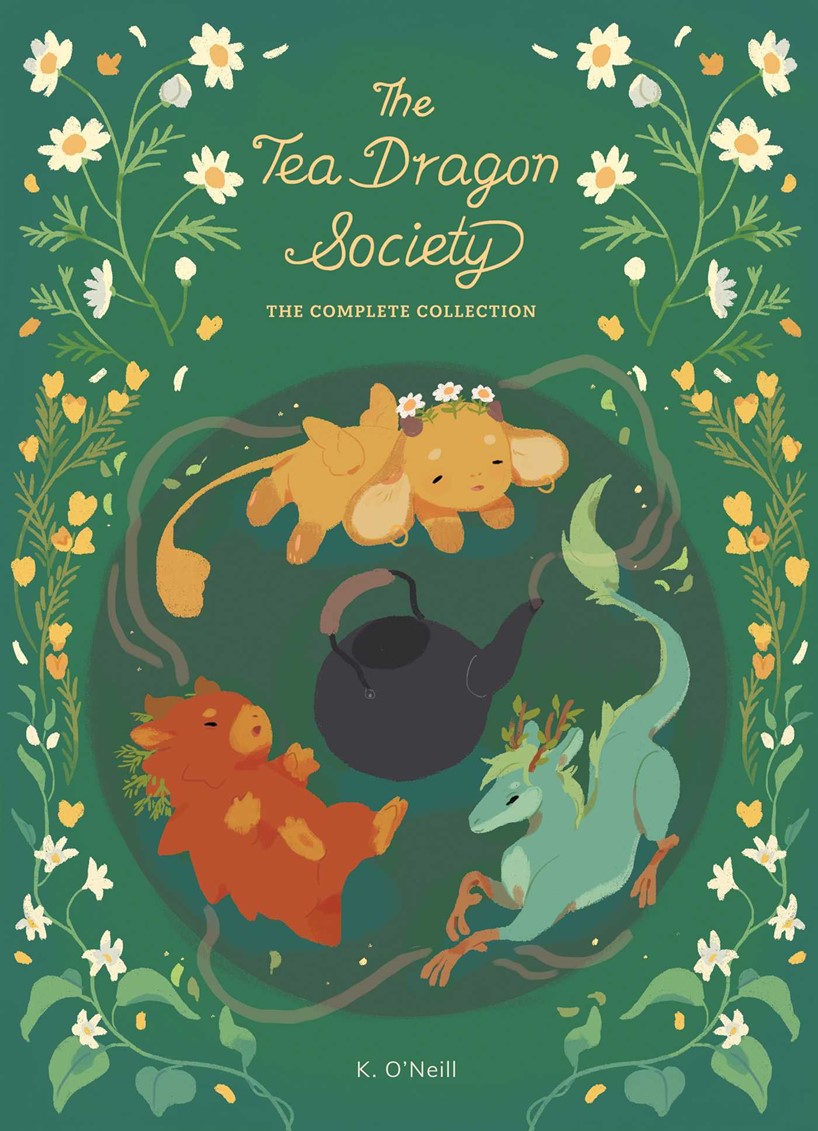
O’Neill, Kay (2016-2021)
The Tea Dragon Society (Series)
Oni Press
Recommended by Federica Clementi
The Tea Dragon Society trilogy, composed of The Tea Dragon Society (2016, 2017), The Tea Dragon Festival (2019), and The Tea Dragon Tapestry (2021), makes a valuable contribution to contemporary graphic literature for young readers. New Zealand author and illustrator K. O’Neill has created a world where humans, animals, and magical creatures coexist in a series that centres on Greta, a young apprentice blacksmith. After rescuing a tea dragon from wolves, she discovers it belongs to tea shop owners Hesekiel and Erik. They teach her to care for these small creatures, and introduce her to their ward, Minette, a mysterious girl who has lost her memories.
The trilogy stands out for presenting inclusivity as an integral yet unremarkable aspect of its world. Same-sex relationships and non-normative identities are integrated naturally, without being framed as exceptional. This normalization extends to representations of ability and embodiment, including visible and invisible disabilities depicted with nuance. Visual diversity further reinforces this ethos: varied skin tones, body shapes, and cultural markers contribute to a sense of multiplicity without othering. From the outset, the narrative depicts a world in transition, where traditions risk fading. Rather than emphasizing loss, it foregrounds belonging, intergenerational knowledge, and resilience, framing diversity as a source of growth rather than conflict. The motif of uncertain traditions parallels the exploration of uncertain identities, positioning identity as something negotiated through community and care.
The publication of The Tea Dragon Society coincides with the growing recognition of graphic novels in children’s literature (Short, 2018), alongside increased attention to comics as pedagogically valuable texts (Derbel, 2019). The trilogy is suitable for students aged 9–12. Its accessible language, combined with strong visual scaffolding, is effective in multilingual and second-language contexts, where images support comprehension alongside developing linguistic proficiency (Liu & Tseng, 2024; Kumar, 2025). Furthermore, its clear panel structure and expressive character design guide readers through the narrative while supporting the interpretation of emotional nuance and relationships. The trilogy’s thematic focus on care, empathy, and identity aligns with educational approaches that emphasize reflective and socially aware learners.
In the classroom, the trilogy lends itself to a wide range of activities. Close reading can focus on how visual elements, such as colour, layout, facial expressions, and body language, contribute to storytelling. Students can engage with questions of identity, memory, change, and community. Discussions may consider how the absence of conflict around difference shapes readers’ perceptions, and how inclusivity is conveyed visually rather than explicitly. Creative extensions might include student-produced comics, multimodal storytelling tasks, or craft-based projects inspired by the text’s emphasis on making and learning. Creative practices can also connect the narrative to real-life experiences through reenactments or performing dialogue.
By combining accessibility with thematic depth, the trilogy offers a coherent and engaging resource that supports both language development and broader educational aims, making it a particularly strong fit for contemporary English language classrooms. In this way, the text not only supports language development but also fosters creativity, empathy, and intercultural understanding, making it a compelling and forward-looking resource for English language education.
Bibliography
O’Neill, Kay (2016). The Tea Dragon Society. Self-published. http://teadragonsociety.com/
O’Neill, Kay (2017). The Tea Dragon Society. Oni Press.
O’Neill, Kay (2019). The Tea Dragon Festival. Oni Press.
O’Neill, Kay (2021). The Tea Dragon Tapestry. Oni Press.
References
Derbel, E. (2019). Teaching literature through comics: An innovative pedagogical tool. International Journal of Applied Linguistics and English Literature, 8(1), 54-61.
Kumar, S. (2025). The Use of Graphic Novels as a Pedagogical Tool in Multilingual Classrooms: Expectations and Challenges. Fortell Peer-reviewed Journal of Teaching English Language and Literature, 50, 157–168.
Liu, Y. T., & Tseng, W. T. (2024). Seeing to understand better? The interplay between cognitive traits and nonverbal visual cues in L2 video comprehension. System, 123. https://doi.org/10.1016/j.system.2024.103328
Short, K. G. (2018). What’s trending in children’s literature and why it matters. Language Arts, 95(5), 287-298. https://doi.org/10.58680/la201829584
|
Federica Clementi (she/her) is a PhD research fellow at the University of Stavanger (Norway). Her research explores the integration of queer children’s literature and arts-based activities in English language education. She is particularly interested in queer literature, multimodal storytelling, and democratic pedagogies. Prior to beginning her doctoral research, she completed her MA in Literacy Studies with a focus on contemporary theatre and feminist perspectives, then worked as an English teacher in primary school and as a freelance language editor. |
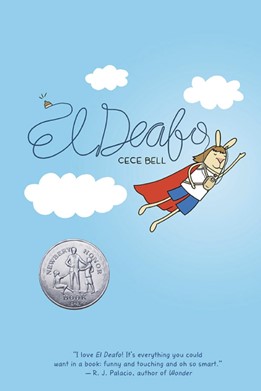
Bell, Cece (2014)
El Deafo
Amulet Books
Recommended by Mathilde Myrstad
Cece Bell’s El Deafo (2014) is a graphic novel that offers a humorous yet thoughtful account of growing up with hearing loss and learning to accept oneself. The novel is based on Bell’s own childhood, with the title stemming from the nickname she gave herself after becoming deaf at a young age. The story follows Cece as she navigates school, friendships, and identity. What makes El Deafo particularly memorable is not only its warmth and accessibility, but the way it uses the graphic novel form to bring Cece’s auditory world to life, with the integration of visual cues, expressive lettering, and simple dialogue, which helps English language learners grasp meaning throughout the story, making the text both engaging and pedagogically valuable.
A central strength of El Deafo lies in its visual representation of sound. Bell powerfully demonstrates the possibilities of the graphic novel genre by making hearing, and the absence of hearing, visible on the page. Speech bubbles fade, break apart, or, contrastingly, take up a large part of the panel with bold, enlarged fonts and colours (Bell, 2014, p. 40). At times, silence is shown through empty space (Bell, 2014, p. 12). These visual choices allow readers to experience confusion, distance, and intensity alongside Cece. As Smith and Pole (2018) note, in El Deafo specifically, the inclusion of visual conventions adds complexity to the frames, which invites students to explore with curiosity (p. 173). This form of sound design also encourages readers to interpret not only what is said, but how it is constructed through a multimodal lens. For learners of English, such a design creates opportunities for strong and differentiated support for comprehension, as visual cues guide meaning and invite deeper engagement with the text (Rimmereide, 2021, p. 225).
The story also invites reflection on difference in perspective and identity. Cece’s story can function as what Rudine Sims Bishop (1990) describes as ‘mirrors’, ‘windows’, and ‘sliding glass doors’, as some readers may recognize their own experience, while others are given insight into a perspective unlike their own (p. 1). One central aspect of Cece’s story is that the narrative does not present deafness as something that must be overcome. Instead, as Smith-D’Arezzo and Holc (2016) suggest, the novel ‘opens up a space for alternative notions of embodiment’ (p. 72). In scenes where Cece imagines herself as the superhero El Deafo, the hearing aid transforms how she navigates her world, giving her a sense of power and confidence, while also reminding her that she experiences spaces, such as classrooms and playgrounds, differently from her peers (Bell, 2014, p. 118).
In English language teaching, such moments provide valuable opportunities for discussion about communication, inclusion, and the different ways people experience the world. One possible activity would be to have students select panels where sound is represented and create a short ‘sound map’ for the scene, using arrows, colours, or lettering to show how different sounds are expressed visually. This activity focuses on visual literacy alongside language skills, while centring student participation and input. A second activity could invite students to design their own superhero based on their identity, considering what special abilities or symbols represent their strengths and experiences. Students can then create a short comic panel featuring their superhero. Personally, I find that the accessible language and strong visual support make the novel suitable for learners aged 8 to 13. At the same time, its themes of identity, belonging, and self-expression resonate across age groups. El Deafo is a compelling text that encourages students to reflect on different perspectives and engage with language in a meaningful and personal way. It is a highly recommended text for the EAL classroom.
Bibliography
Bell, Cece (2014). El Deafo. Amulet Books.
References
Bishop, R. S. (1990). Mirrors, Windows and Sliding Glass Doors. Perspectives: Choosing and Using Books for the Classroom, 6(3), ix–xi.
Rimmereide, H. (2021). Graphic novels in the English classroom. In G. Williams & Normann A. (Eds.), Literature for the English Classroom (2nd ed.) (pp. 197-228). Fagbokforlaget.
Smith-D’Arezzo, W. & Holc, J. (2016). Reframing Disability through Graphic Novels for Girls Alternative Bodies in Cece Bell’s El Deafo. Girlhood Studies 9(1), 72-87. https://doi.org/10.3167/ghs.2016.090106
Smith, J. M. & Pole, K. (2018). What’s Going on in a Graphic Novel. The Reading Teacher 72(2), 169-177.
|
Mathilde Myrstad is a graduate of the Master’s program in primary teacher education (grades 1–7) at the Norwegian University of Science and Technology (NTNU), where she remains active through the research groups CLEAR and ARCLEN. Her research interests include children’s literature, consumerism in children’s media, and affective dimensions in English language learning. Her Master’s research examined consumerism and kinderculture. Her chapter ‘Bridging Perspectives: Using Authentic immigrant Texts to Foster Empathy and Affect in Education’ will be published in the forthcoming Routledge volume Children’s and Young Adult Literature in English Language Teaching: Perspectives from a Norwegian Context. |
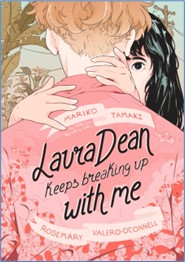
Tamaki, Mariko & Rosemary Valero-O’Connell (2019)
Laura Dean Keeps Breaking Up with Me
First Second
Recommended by Iria Seijas-Pérez
In recent years, there has been an increase in the publication of queer stories for young readers that break away from tragic and prejudiced storylines and that focus on the characters’ lives beyond their sexuality (see e.g., Jenkins and Cart 2018). This includes graphic novels for the YA audience, and a remarkable example is Laura Dean Keeps Breaking Up with Me (2019), written by Mariko Tamaki and illustrated by Rosemary Valero-O’Connell. Following its publication, the work has been praised for both its writing and artwork, having received a number of comic book awards.
Set in California, the novel follows 17-year-old Freddy’s complex – or rather, toxic – relationship with her girlfriend Laura. Their on-and-off relationship leads Freddy to distance herself from her friends. As Laura repeatedly breaks up with her and asks to reunite, Freddy becomes increasingly focused on meeting Laura’s demands. As the narrative develops, Freddy realizes that in prioritizing Laura, she has driven herself away from her best friend, Doodle, who is struggling with an unwanted pregnancy. Freddy must therefore come to terms with the damaging nature of her relationship to Laura.
Hence, Laura Dean Keeps Breaking Up with Me centres lesbian and queer characters whose identities extend beyond their sexuality. In doing so, the novel offers a broader perspective of sapphic identities. While queerness unavoidably marks one’s experiences in a heteronormative society, the novel approaches a variety of struggles that can be faced by any adolescent, such as toxic relationships, manipulation, teenage pregnancy, and neglected friendships. That adolescent readers have access to texts that address these issues becomes valuable as it can help them navigate and understand the different difficulties that can arise from messy relationships. Moreover, the universality of these themes makes the novel relevant to both straight and queer audiences, acting as both window and mirror (see Bishop, 1990) to educate and inform young readers. Regarding the visual mode, the design stands out for its combination of black and white with a soft shade of pink in some scenes. This easily attracts the attention of readers, occasionally highlighting notable narrative elements and easing the reading of the text. This selective use of colour not only draws attention to key emotional moments but also reinforces the affective tone of the narrative.
In short, Laura Dean Keeps Breaking Up with Me can become an asset to the English classroom – particularly in higher grades due to pupils’ potential interest in and understanding of the topics – as it can encourage significant discussions about the different events that take place in the novel. Furthermore, it contributes to the visibility of queer stories, which also deserve a space in the classroom, and the due recognition of sapphic girlhood experiences.
Bibliography
Tamaki, Mariko, & Valero-O’Connell, Rosemary (2019). Laura Dean Keeps Breaking Up with Me. First Second.
References
Bishop, R. S. (1990). Mirrors, windows, and sliding glass doors. Perspectives: Choosing and Using Books for the Classroom, 6(3), ix–xi.
Jenkins, Christine A., & Cart, M. (2018). Representing the Rainbow in Young Adult Literature: LGBTQ+ Content since 1969. Rowman & Littlefield.
|
Iria Seijas Pérez is a substitute lecturer at the University of Extremadura and a member of the research project ‘Communitas/Immunitas: relational ontologies in Atlantic anglophone cultures of the 21st century.’ Her most recent publication is the monograph Sapphic Adolescent Girls in Irish Young Adult Fiction: Queering Girlhood (Routledge, 2025). Her research interests include YA literature, Irish literature, and queer studies. |